
Celestial Wedding Dresses: How Stars, Moons, Shimmer, and Sheer Layers Change the Design

By Orly Lauren Doubinsky, Founder and Technical Designer of Studio RÉN
Celestial wedding dresses use stars, moons, constellations, or light-reflective detail, but the motif alone does not make the gown refined. What decides the result is how the embellishment is scaled, distributed, supported, and placed across the pattern. A beaded star changes the weight and behavior of tulle very differently from thread embroidery, and a sheer celestial overlay still needs a stable internal foundation underneath it. This guide works through those decisions the way a technical designer does before fabric is cut, using original Studio RÉN illustrations and 3D design comparisons rather than a shopping roundup.

Studio RÉN's Celestial Wedding Dresses Approach
Start with support and silhouette. Establish the celestial motif path across the pattern and in 3D, confirm placement and density on the same avatar, then verify bead weight, opacity, and light response using the selected physical materials. 3D narrows placement, scale, distribution, color relationships, and proportion before production. Material behavior is confirmed through swatches and the physical sample.
What You'll Learn
How motif density and focal placement decide whether a gown reads hand-beaded or printed
How a constellation survives across corset seams, cups, boning, and the waist
When celestial detail belongs on the gown and when it belongs on a removable veil, cape, or overskirt
How underlayer color and layer count control transparency, contrast, and whether black reads bridal
What a 3D preview can establish before production, and what still needs physical fabric
What a custom celestial gown costs and how far ahead to start
Table of Contents
1. What a Celestial Wedding Dress Is
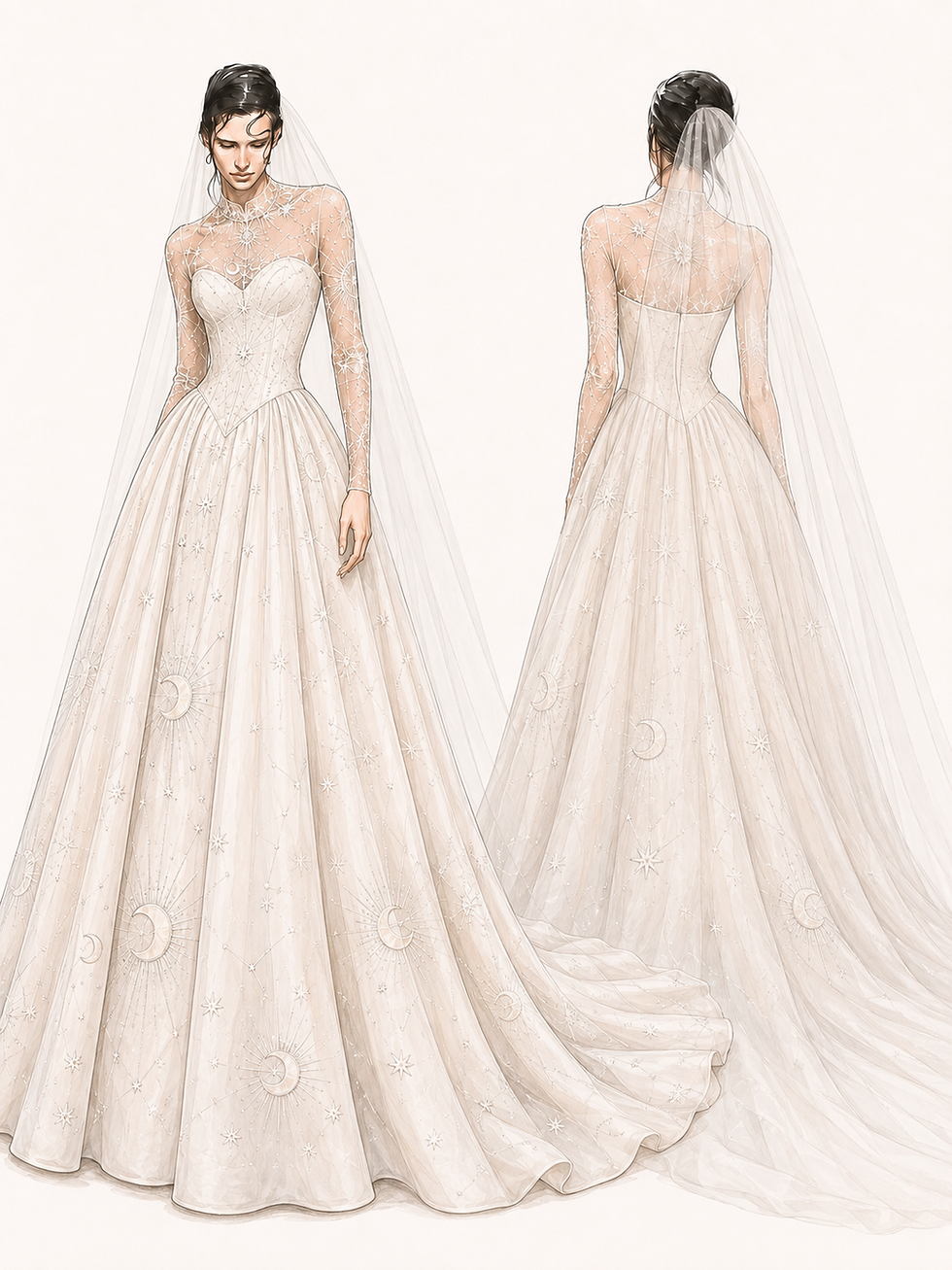
A celestial wedding dress is defined by a visual language, not a silhouette. It draws on stars, moons and moon phases, constellations, sunbursts, comet trails, and light: metallic thread, crystals, sequins, pearls, reflective beads, iridescent or opalescent fabric, and layered tulle that builds atmospheric depth. Because it is a language and not a shape, it can be applied to a fitted gown, an A-line, a ball gown, a slip dress, a veil, a cape, sleeves, or a detachable overskirt.
That distinction is the whole reason this article exists: the silhouette carries the fit and the support, and the celestial treatment sits on top of it. Every decision below is about how those two layers behave together. Pinterest's 2026 Wedding Trend Report reported a 1,330% increase in searches for "celestial whimsigoth." That signals growing interest in a specific celestial and alternative aesthetic, but it does not resolve the construction decisions behind a wearable bridal gown.

2. Four Studio RÉN Celestial Wedding Dress Design Studies
These are not four pretty dresses. Each starts from a construction problem, compares controlled options on the same avatar, and ends with the direction Orly would choose and why. The verdict is the point.
Design Study 1: Starlight Scatter

The problem: How dense should star embellishment be, and where should it sit?
What we compared: The same gown on the same avatar at three densities, sparse, medium, and dense, with the dense version shown two ways, uniform all-over and concentrated toward the bodice:

A sparse Starlight Scatter leaves generous space between motifs on this warm-ivory strapless basque-waist ball gown. The structured corset, full tulle skirt, and train remain visually dominant, with celestial embroidery used as a restrained accent.
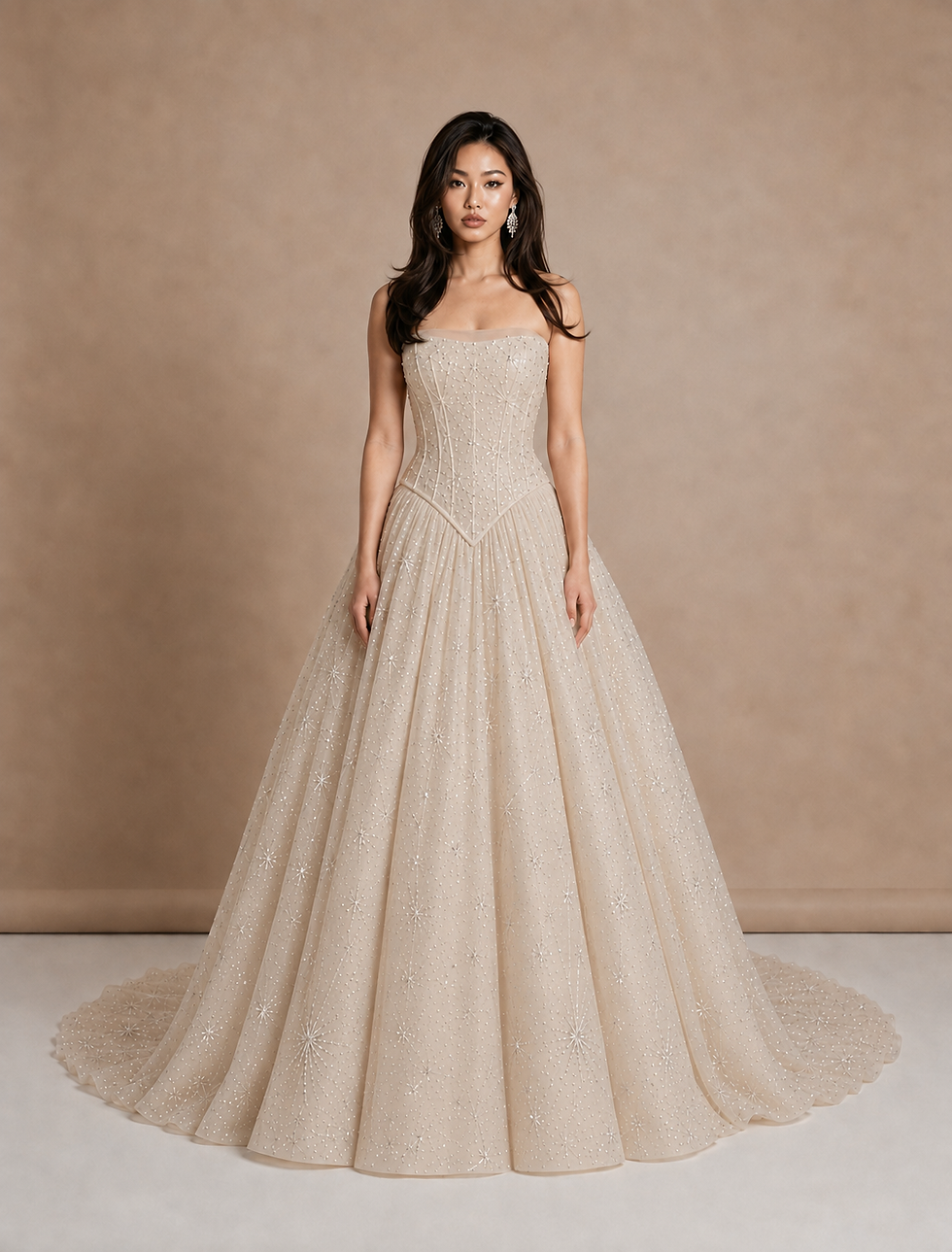
Medium-density Starlight Scatter creates continuous celestial detail across this strapless basque-waist ball gown without obscuring the corset seams or dimensional tulle folds. The varied star scale keeps the surface from reading as a rigid repeat.

Dense, evenly distributed Starlight Scatter covers the structured corset, full tulle skirt, and train of this warm-ivory basque-waist ball gown. The consistent density creates maximum sparkle, but it can flatten the silhouette and make the hand-placed motifs resemble a repeated surface pattern.
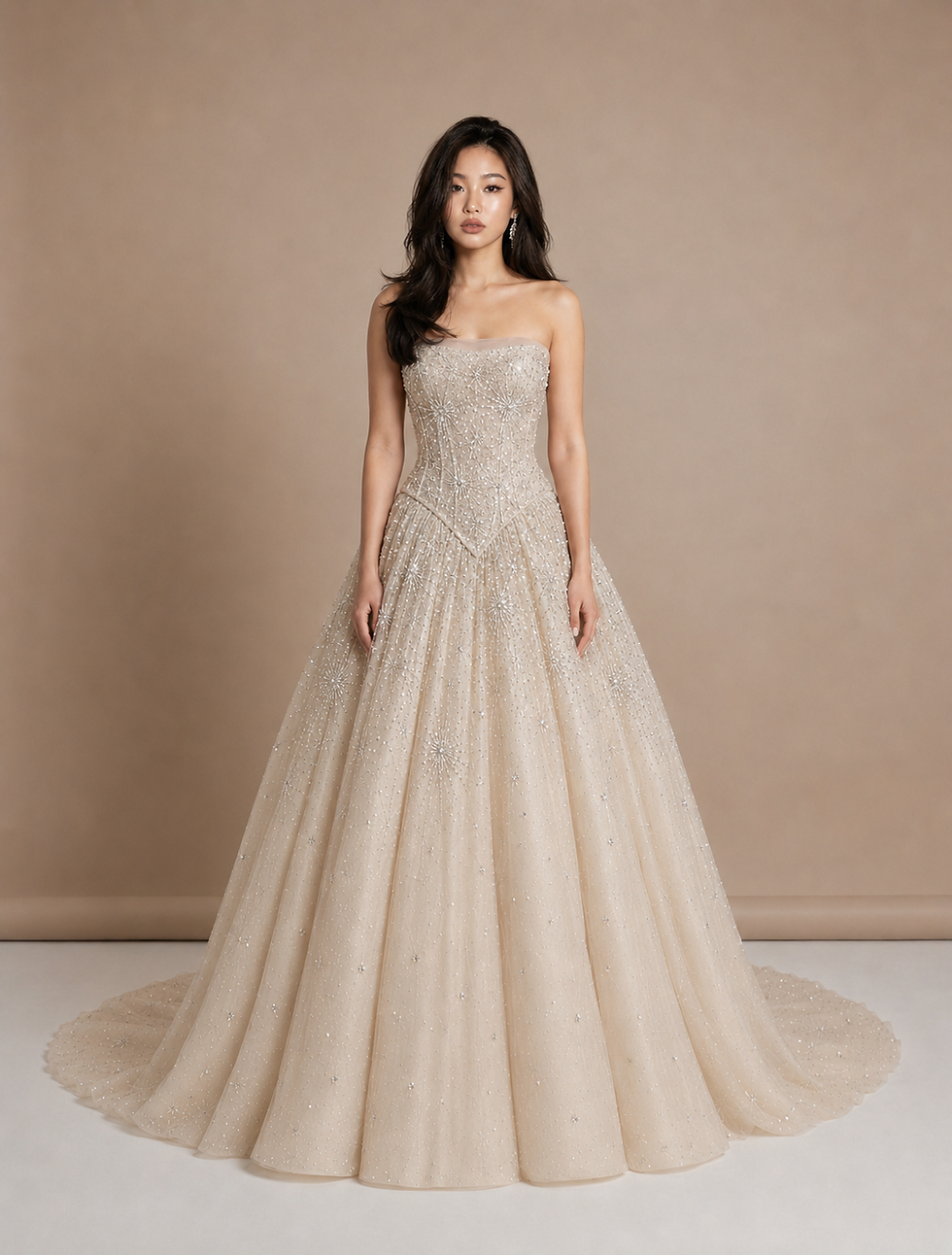
Dense Starlight Scatter is concentrated across the strapless corset and upper skirt of this warm-ivory basque-waist ball gown, then gradually fades toward the hem and train. The graduated placement keeps the focal point near the face and bodice while preserving the volume and movement of the tulle skirt.
The verdict: Concentrate the beadwork in the upper third of the gown and let it thin as it descends toward the hem. Uniform all-over scatter is the weakest option, because evenly spaced identical motifs can read as a printed repeat under direct flash, flattening the hand-placed effect into a uniform surface. A graduated field, denser at the bodice and dissolving into the skirt, keeps a focal point at the face and torso and lets the eye travel instead of flattening the whole gown into texture.
When the verdict flips: All-over density can work when the motifs vary in scale and are not on a strict grid, so the eye reads a scattered sky rather than a repeat. Dense-but-refined is a real option; dense-and-uniform is the trap.
What 3D establishes: Placement, density, focal area, and whether the scatter overwhelms the silhouette.
What still needs fabric: whether concentrated bodice beadwork adds enough weight to require extra support is confirmed on the real garment, not on screen.
Design Study 2: Constellation Corset

The problem: A constellation is a continuous line of points. A structured bodice is a set of separate shaped panels. How do you run one across the other without the shaping breaking the picture?
What we compared: The same constellation handled two ways, added to a finished corset without regard to seam position, versus its path planned across the pattern and confirmed in 3D before the motif is committed.
The verdict: Establish the constellation path in 3D and across the pattern first, then confirm the fitted corset, outer shell, and final seam positions before committing the motif. The application sequence then depends on the method. For individual beads or repositionable appliqués, place them after the outer shell has been assembled and stabilized, because the constellation can be corrected where a curved seam shifts it. Engineered embroidery is different: it can provide the greatest repeatable control when the motif is registered precisely to each pattern panel, but it must be registered before cutting, so it is reserved for production partners capable of that precision and for budgets that allow the necessary sampling. What you never do is apply a constellation to an already-finished corset without planning the path, because the shaping at princess seams and cups pulls the motif out of alignment and a star that should sit on a seam ends up split or skewed.

The honest limitation: Mapping first commits you earlier and, for engineered embroidery, removes the ability to nudge a motif later. That control costs sampling time and budget.
What 3D establishes: Whether the mapped line reads as continuous across the shaped bodice, and where it breaks.
What still needs fabric: the behavior of embroidery across a boning channel under tension is confirmed in the sample.

Design Study 3: Moonlit Veil or Cape

The problem: Should the celestial drama live on the gown, or on a layer the bride can remove?
What we compared: A relatively clean gown shown three ways, with the celestial treatment on the gown itself, on a moon-and-star veil, and on a cape.
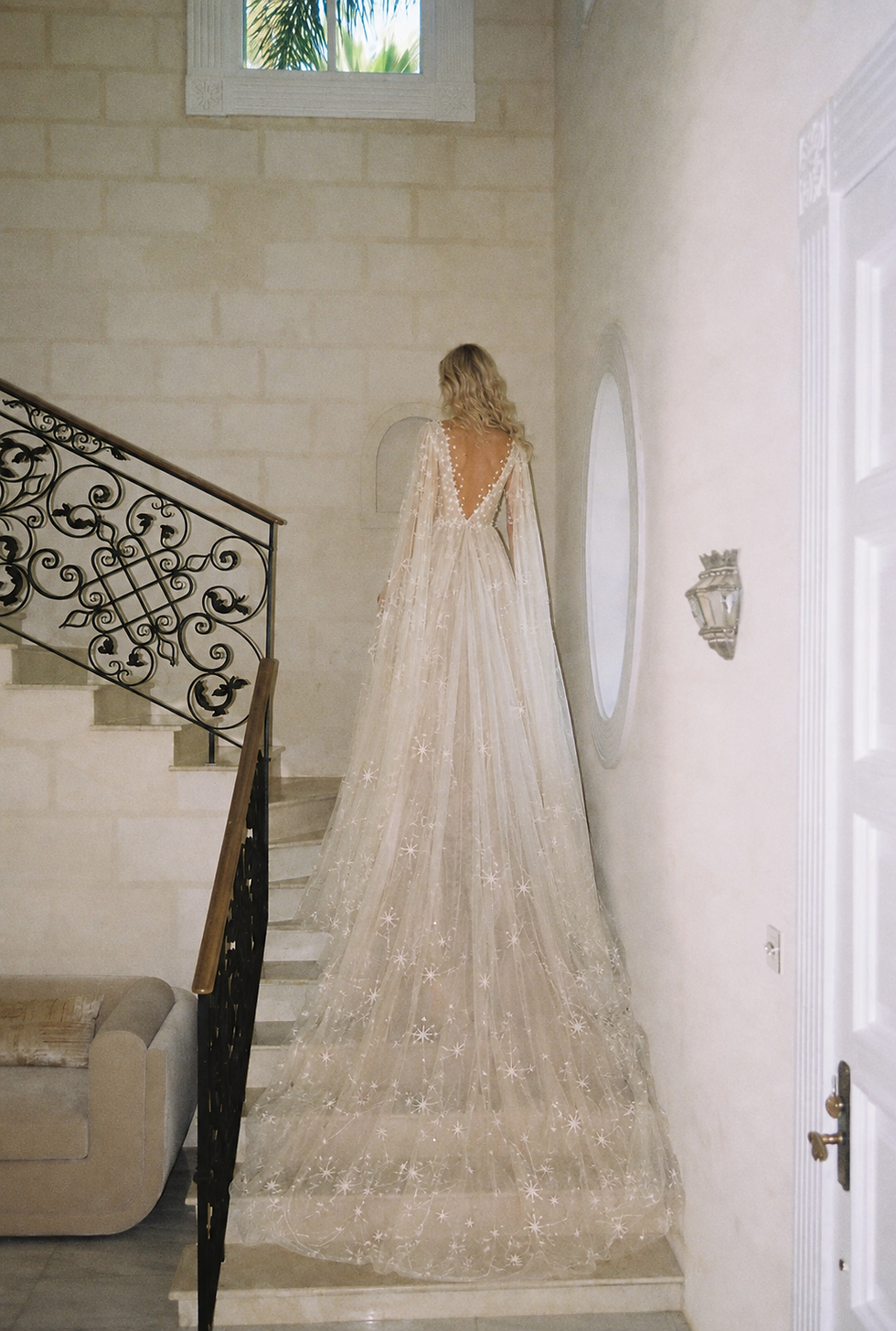
The verdict: For most brides who want celestial impact for the ceremony and a cleaner reception look, put it on a removable layer, and default to the veil over the cape. A veil carries the motif without touching the gown's fit or structure, which keeps the fitted layer clean and alterations simple. A cape delivers a longer, more dramatic celestial train, but it transfers its weight to the shoulders or neckline, so it has to be engineered to hang from a supported edge rather than a delicate one. The gown-integrated version is the right call only when the bride wants celestial to be the dress, and is accepting the higher effect on weight, seams, and cost that comes with it.
What 3D establishes: Motif orientation when fabric hangs vertically behind the body, and how a train's length changes motif spacing.
What still needs fabric: the selected cape fabric, motif density, closure, and neckline foundation must be tested together. Studio RÉN does not claim a universal safe-weight threshold without those materials.

Design Study 4: Midnight and Opal Layers
The problem: Color is not one decision. The outer tulle, the underlayer beneath it, and the number of layers each change the result independently. How do they interact?
What we compared: The same sheer celestial outer layer over several underlayers, warm ivory, silver, soft blue-gray, and black.

Warm-ivory tulle softens the contrast around this open-back, warm-ivory silk halter wedding dress with a chapel-length train. The cathedral veil is spread wide to reveal off-white, pale-silver, and antique-gold embroidered suns, crescent moons, stars, and constellation lines.

Silver tulle creates a cooler contrast against this open-back, warm-ivory silk halter wedding dress and chapel-length train. The spread cathedral veil carries off-white, pale-silver, and antique-gold sun, moon, star, and constellation embroidery.

Soft blue-gray tulle gives this open-back, warm-ivory silk halter wedding dress and chapel-length train a cooler, more atmospheric frame. The cathedral veil features large off-white, pale-silver, and antique-gold suns, crescent moons, stars, and constellations.

Sheer black tulle produces the strongest contrast with this open-back, warm-ivory silk halter wedding dress and chapel-length train. The darker base makes the off-white, pale-silver, and antique-gold celestial embroidery more prominent across the spread cathedral veil.
The verdict: Treat the outer layer and the underlayer as two separate levers, and reach for the underlayer first. Changing the underlayer shifts the entire mood while leaving the celestial motifs where they are: a cool silver underlayer sharpens silver embellishment, warm ivory softens it, and a skin-tone underlayer selected for the avatar reads as "nude" far more truthfully than one generic beige, because nude is not one color. For black and midnight gowns, layer count is one of the main controls: sparse black tulle may read gray, while additional layers deepen the color. Structure can remain visible wherever layer count, lining color, or lighting creates contrast, so cups, seams, and boning must be concealed deliberately.
The honest limitation: Every one of these color relationships shifts under real light and real fabric. The 3D comparison shows the relationship; it does not promise the exact tone. (For more on working with dark celestial layers, see the Black Wedding Dresses guide.)
What 3D compares: Color relationships, contrast, relative transparency, and whether structure shows through.
What still needs fabric: true tone and true opacity of the selected tulle over the selected lining, confirmed on swatches.
Studio RÉN Celestial Defaults at a Glance
Decision | Studio RÉN default | When it changes |
Motif density | Concentrated at the bodice, tapering down | All-over can work when motif scale and spacing vary |
Constellation corset | Map the path first; place beads or appliqués after the shell is stabilized | Engineered embroidery when a partner can register motifs precisely and the budget allows sampling |
Veil or cape | Veil for removable celestial impact | Cape for greater drama with an engineered, supported closure |
Outer and underlayer color | Change the underlayer first | Change the outer layer when motif contrast also needs to shift |
Define Your Bridal Vision
Turn Celestial Inspiration Into a Clear Gown Brief
A folder of celestial pins shows only the mood. The free Studio RÉN Custom Gown Vision Guide helps you define motif, color, support, proportion, budget, and timeline before a design consultation.

3. Embroidery, Beading, and What Must Be Physically Tested
Two things get confused constantly: what embroidery and beading do, which is knowable from experience, and how much they do it, which is only knowable by testing the actual production fabric.
Consideration | Thread embroidery | Beading, crystals, or sequins |
Visual effect | Defines lines and shapes | Reflects light, adds dimensional sparkle |
Weight | Usually lighter, depends on density | Can add considerable distributed weight |
Fabric behavior | May stiffen or stabilize the mesh | Can pull, stretch, or distort lightweight mesh |
Placement | Can be engineered before cutting | Applied before or after assembly |
Seam risk | Motifs may be cut or interrupted | Beads may need removal and replacement near seams |
Photography | Usually creates a more continuous visible motif | Reflections change with angle, flash, and movement |
Cost | Scales with embroidery complexity | Scales with material, density, hand placement |
Embroidery is not always light, and beading does not always damage tulle. The outcome depends on the base fabric, the motif density, how the weight is distributed, the application method, and the support underneath.
On fabric behavior, the mechanism is knowable and the magnitude is not. Distributed embellishment weight can cause lightweight or stretch tulle to lengthen or distort over time, which is why a heavily beaded gown should hang before the hem is finalized. Heavily embellished sleeves can drop or rotate differently from plain ones. A beaded bodice may require a stabilizing layer beneath the decorative one. Those are directional truths. The numbers, exact elongation, recovery, added weight, how far a hem grows, depend on the selected mesh, embellishment density, application method, and underlying support, and come from testing the production fabric.
This article does not publish them from a screen.
4. Constellations Across Seams and Hidden Corsetry
This is where celestial gowns are won or lost, and it is the part a shopping roundup cannot cover.

A motif that has to cross a bust dart, a princess seam, a side seam, a waist seam, a boning channel, a zipper, a neckline edge, a sleeve seam, or a train seam is a production decision, not a styling choice. The verdict is set in the
Constellation Corset study above: map the path first, then let the embellishment method decide the sequence. In application terms, that leaves three methods. Engineered embroidery can give the greatest repeatable control when a partner registers the motif precisely to each panel before cutting, at the cost of commitment and sampling. Cutting around motifs and repositioning them as appliqués is more flexible, letting you move a motif off a bad seam line at the cost of additional hand labor. Assembling the structure first and adding beads or appliqués afterward protects the corsetry and allows correction across curved seams, which is Studio RÉN's default. Which one fits a given gown follows from the embellishment method and the sampling budget.
5. Motif Density, Underlayer Color, and Body-Specific Proportion
There is a lazy version of this section that says petite brides need small motifs and plus-size brides need large ones. It is wrong often enough to be worthless.
Motif scale and placement depend on how the specific body reads: torso length, bust projection, shoulder width, where the waist sits, hip balance, skirt volume, height, and train length, plus where the eye should land. The same celestial design on two avatars with different proportions is not the same design enlarged. It is the same design with the spacing and focal point re-placed for that body, so the concentration of light supports the intended focal point and overall proportion rather than sitting where a grid put it.
This is also why the "costume" effect happens, and it is not simply "too much sparkle." Dense embellishment can look refined when it is controlled. The costume look comes from competing decisions stacking up: identical motifs at uniform intervals, oversized literal moons and stars with no hierarchy, saturated color plus heavy shine, equal sparkle everywhere, and theatrical sleeves, corsetry, color, and embellishment all shouting at once. Refinement is hierarchy: one element leads, the rest support it.
6. Dress Versus Veil, Cape, or Overskirt
If a bride wants to change her look between ceremony and reception, or wants celestial drama without committing her whole gown to it, placement is the lever.

Placement | Best for | Technical risk |
Main gown | A fully integrated celestial identity | Highest effect on weight, fit, seams, cost, alterations |
Veil | A clean gown with removable celestial detail | Motifs must read while fabric is layered and moving |
Cape | Ceremony drama or a long celestial train | Weight and closure must be supported at shoulder or neckline |
Overskirt | A ceremony-to-reception transformation | Adds waist bulk, needs a secure attachment |
Sleeves | Concentrated detail near the face and bodice | Weight can affect sleeve drop, mobility, armhole balance |

A sheer celestial layer, wherever it sits, does not remove the need for a foundation. An integrated sheer gown still needs an internal corselet, cups, boning, and waist stay selected and positioned for the bride's bust, plus stable neckline and armhole edges, with the structural seams concealed beneath the scattered motifs. Where a constellation crosses the waist seam, its placement is planned around that seam, not dropped over it. Laying embroidered tulle over a standard strapless lining and hoping is not support.
7. What a 3D Preview Can and Cannot Show

This is a design and proportion review before production. It is not a virtual fitting, and calling it one would overpromise.
On the same 3D avatar, a celestial gown can be compared at three motif densities, two motif scales, two underlayer colors, and as an integrated gown versus a detachable celestial layer. The preview can narrow placement, scale, distribution, focal areas, color relationships, approximate transparency, and overall proportion, including whether the celestial layer overwhelms the silhouette.
It cannot confirm real bead weight, exact fabric stretch and recovery, true crystal reflection, final hand-beading quality, movement while walking or in wind, or the result under every lighting condition. Metallic thread usually creates a more continuous visible motif, while sequins and crystals produce isolated reflections that change with angle, flash, and movement. Iridescent materials may shift color, dense sparkle may obscure motif detail under flash, and subtle embellishment may disappear in wide daylight photographs. The preview narrows design and proportion decisions. Swatches and the physical sample confirm material behavior and final light response.
8. Cost and Timeline
Studio RÉN custom gowns start at $3,000, with most falling between $3,000 and $5,500. Couture-level gowns run approximately $4,500 to $9,500+. A celestial gown moves up that scale when it involves custom embroidery development, dense beadwork, engineered motif placement mapped to the pattern, or multiple detachable pieces, so a heavily beaded or pattern-matched celestial design is more likely to sit in the higher custom or couture range. A cleaner celestial gown, or one that puts the drama on a removable veil, does not automatically cost $4,500 or more.
The preferred starting timeline is 9 to 12 months before the wedding. Celestial gowns benefit from the full window because custom embroidery or beadwork development, sampling, and a hang-before-hem stage add production time.
If you are still weighing custom, semi-custom, made-to-measure, and made-to-order, that guide explains which tier a celestial gown belongs to. See the online custom gown process for full details.
9. Celestial Wedding Dress FAQ
What is a celestial wedding dress?
A celestial wedding dress uses stars, moons, constellations, or light-reflective detail as its design language, applied through embroidery, beading, iridescent fabric, or layered tulle. It is a visual style, not a specific silhouette, so it can appear on a fitted gown, a ball gown, a slip dress, a veil, a cape, or a detachable overskirt.
Is embroidery or beading better for celestial motifs?
Neither is universally better. Embroidery defines lines cleanly, tends to be lighter, and can be engineered before cutting. Beading and crystals add dimensional sparkle and light play but can add distributed weight and distort lightweight tulle. The right choice depends on the base fabric, density, and how the gown is supported.
How do you keep a celestial wedding dress from looking like a costume?
Hierarchy. The costume effect comes from identical motifs at uniform intervals, oversized literal moons and stars, saturated color plus heavy shine, and everything competing at once. A refined gown concentrates the embellishment into a focal area and lets one element lead.
Can a sheer celestial gown support a large bust and different proportions?
Yes, but the support comes from the internal structure, not the sheer layer. That means an internal corselet or structured bodice, cups positioned for the bride's bust, correct boning, and a waist stay, with the structural seams concealed beneath the motifs. Motif scale and placement are then adjusted to the individual body rather than to a fixed rule.
What can a 3D preview establish before production?
A 3D preview can compare motif placement, scale, distribution, focal areas, color relationships, approximate transparency, and overall proportion, including whether the celestial layer overwhelms the silhouette. It cannot confirm real bead weight, exact fabric stretch, true crystal reflection, final movement, or exact opacity, which require swatches and the physical sample.
How much does a custom celestial wedding dress cost, and how long does it take?
Studio RÉN custom gowns start at $3,000, with most between $3,000 and $5,500 and couture-level gowns approximately $4,500 to $9,500+. Dense beadwork, custom embroidery, engineered motif placement, or detachable pieces push a celestial gown toward the higher range. The preferred timeline is 9 to 12 months before the wedding.
Preview Your Celestial Wedding Dress Before Production

Share your silhouette, motif, color, and references in 3 to 5 minutes. Studio RÉN reviews your direction, budget, and timeline first. If the project fits Studio RÉN's custom service, you will be invited to a free 30-minute online consultation to discuss the design and 3D preview process.
3 to 5 minutes. No final measurements required. Custom gowns start at $3,000.
Orly Lauren Doubinsky is the founder and technical designer of Studio RÉN. She holds a B.Des from Shenkar and brings more than 15 years of experience in women's technical design across fit, pattern development, garment construction, 3D development, and global production with international brands.
Sources and Methodology
The trend reference comes from Pinterest's 2026 Wedding Trend Report. The illustrations and 3D design comparisons are original Studio RÉN work. Technical verdicts reflect Orly Lauren Doubinsky's design and production judgment. No physical swatch test was conducted for this article. Final bead weight, stretch, opacity, and light response must be confirmed using the selected production materials.


Comments