
Greek Goddess Wedding Dresses: How Ancient Draping Becomes Modern Bridal Design

A Greek goddess wedding dress only looks effortless.
Underneath the drape sits a foundation that determines whether the fabric falls into clean vertical folds or twists, sags, and pulls the moment the bride moves. The difference between a modern Grecian bridal gown and something that looks like a costume is rarely the amount of fabric on the outside. It is the control built into the inside.
Grecian dressing is having a cultural moment again, so this is a useful time to look past the fantasy and examine how mythological inspiration becomes a wedding dress that can actually be worn.
This post translates six Greek goddesses into distinct bridal designs, then looks beyond the goddesses to Penelope, whose connection to weaving makes her one of the most technically relevant women in ancient Greek storytelling.
Each design begins with a different construction problem. Bias fabric that stretches. A one-shoulder bodice that rotates. A draped overfold that shortens the torso. A narrow skirt that still has to allow movement. Sheer embroidery that needs a hidden foundation. Minimal sleeves that pull a clean neckline out of position.
A gown that has to survive standing, sitting, walking, dancing, and photography is a technical garment, not an inspiration board.
What You'll Learn
How six Greek goddess wedding dress concepts translate into specific, buildable construction decisions.
Why effortless Grecian draping usually depends on hidden internal support, grain control, and body-specific proportion.
How the same goddess-inspired design must change across different busts, torso lengths, shoulder widths, and hip proportions.
Table of Contents
Written by Orly Lauren Doubinsky.
Why a Grecian Wedding Dress Still Needs Structure
Ancient Greek dress was built largely from rectangular cloth that was folded, draped, belted, and fastened around the body. Garments such as the chiton, peplos, and himation created long vertical folds without relying on the shaped pattern pieces used in modern fitted clothing. The Metropolitan Museum of Art documents these garment structures and how they were draped rather than tailored.
That is where the visual language of a Greek goddess wedding dress comes from: length, movement, asymmetry, soft folds, and a column that appears to skim rather than grip the body.
A modern bridal gown cannot function exactly like an ancient draped garment.
It has to hold a specific neckline in place, support the bust, manage the weight of a train, sit correctly through a full day, and remain clean in photographs from every angle. The design problem is not simply, "How do I make this look draped?"
The real question is:
How do I make draped fabric behave predictably on one specific body while that body is moving?
A successful Grecian-inspired wedding dress may require:
A stabilized inner bodice underneath the visible drape.
Controlled grain placement so the fabric falls rather than twists.
Support for an asymmetric or one-shoulder neckline, which pulls unevenly by design.
Drape placement adjusted to the bride's bust, waist, torso length, and hip projection.
Enough fabric weight to create vertical folds without overwhelming the body.
A waist stay or internal anchor that prevents the outer layers from dragging downward.
A hem and train engineered for actual walking, not only a static photograph.
Get the internal structure right and the exterior looks effortless.
Skip it and the gown twists, gaps, collapses, or drops. The drape is the visible result. The structure is the work.
Aphrodite: Fluid Draping Without Losing Support

Design language: sensual movement, softness, fluidity.
The construction decision: controlling bias-cut fabric without making it look rigid.
Aphrodite is the bias-cut goddess. Silk satin or silk crepe cut on the bias produces the liquid movement associated with this kind of gown. The fabric follows the body softly, reacts beautifully in motion, and creates a more fluid line than fabric cut on the straight grain.
It is also unstable.
Bias-cut fabric stretches under its own weight. The amount of stretch can change around the bust, hips, side seams, and train because each part of the garment carries a different amount of tension. A bias skirt that appears level immediately after sewing may drop unevenly after hanging.
The design challenge becomes more difficult when the gown also has a draped neckline and low back. Those details remove many of the obvious places where conventional support would normally sit.

Aphrodite: bias-cut silk crepe with a soft cowl neckline. The bust support sits in a stabilized inner cup structure, so the outer silk stays unlined and fluid while the drape holds its shape instead of falling open.

The low draped back removes the usual anchor points, so the support is rebuilt through the front and side bodice. The skirt is cut on the bias, then hung and allowed to relax before hemming, so the train falls evenly rather than dropping unevenly after wear.
The answer is not to line the entire gown heavily and destroy the movement. It is to separate the support system from the visible silk.
A stabilized inner cup structure can support the bust while allowing the outer layer to remain soft. The neckline drape must be controlled at specific anchor points so it falls deliberately rather than opening whenever the bride leans forward. The skirt must be cut accurately, allowed to relax before hemming, and balanced after the fabric has completed most of its natural drop.
The result should still look fluid. The bride should never see how much control is underneath it.
A low cowl back removes almost every place support would normally sit. The fold holds because the bias is cut and hung on grain and the bodice is stabilized through the front and sides, not because the silk is heavy. The floral appliqué follows the drape line rather than sitting across it, so the surface detail reinforces the fall instead of interrupting it.

Fabric direction: bias-cut silk satin or silk crepe, softly draped neckline, low back, stabilized inner cups, minimal pearl or shell-inspired embellishment.
Athena: Asymmetry That Does Not Collapse

Design language: intelligence, strength, architectural control.
The construction decision: supporting a one-shoulder bodice against uneven pull.
Athena is one of the clearest connections between Greek mythology and modern bridal design. In the myths she represents strategy, intervention, and controlled power. Her gown should feel equally deliberate.
The design begins with an asymmetric one-shoulder bodice, architectural pleating, and a clean column or controlled A-line silhouette.
A detachable shoulder drape or structured cape can replace a conventional veil.
Asymmetry is the visual strength of the design. It is also the technical weakness.
A one-shoulder bodice pulls the garment toward the covered side. Without an internal counterbalance, the open side may rotate downward, the neckline may gap, and the shoulder line may gradually shift under the weight of the drape.
The internal foundation therefore cannot be treated as a standard strapless bodice with decorative fabric added over one shoulder.
It must be engineered asymmetrically.

Athena: a one-shoulder bodice with diagonal pleating and a detachable shoulder drape. The pleats are mapped, not gathered. Their direction carries the eye across the body and controls where fabric bulk collects, so one side of the bust does not read larger than the other.

A one-shoulder design pulls everything toward the covered side. The internal foundation is built asymmetrically to answer that: the covered side anchors the weight of the drape, and the open side is stabilized independently, so the bodice holds level instead of rotating as the cape moves.
The covered side needs a secure anchor for the weight of the pleating or cape. The open side needs independent stabilization so it does not move toward the center of the body. The internal support may include asymmetric boning, a waist stay, concealed elastic support, or a carefully placed inner strap system depending on the neckline and back depth.

The same Athena design, rebuilt for a different proportion. The pleat scale is widened so the diagonal reads at this frame rather than disappearing, the drape depth over the bust is increased so the one-shoulder neckline sits closed instead of pulling open, and the waist detail is repositioned to the bride's actual waist rather than a sample-size seam.

The asymmetric support is rebuilt, not resized. A fuller bust and different back depth change how much load the covered shoulder carries, so the internal anchor and the open-side stabilization are both recalculated. The cape hangs from the same point visually, but the structure holding it is not the same pattern.
The pleats also need to be mapped rather than improvised. Their direction controls where the eye travels and where fabric bulk accumulates. Poorly placed pleating can make one side of the bust look larger, shorten the torso, or create tension directly over the neckline.
Athena should look strong because every line has been planned.
Fabric direction: matte crepe, silk faille, or structured satin, one-shoulder bodice, architectural diagonal pleating, asymmetric internal foundation, detachable shoulder drape or cape.
Hera: Regal Proportion on a Corseted Foundation

Design language: ceremony, authority, regal proportion.
The construction decision: scaling a peplos-inspired overfold without shortening the bride's body.
Hera is the most formal and structured of the six goddess designs. Her gown begins with a corseted foundation, defined waist, controlled train, and a folded upper layer inspired by the peplos. The peplos was defined by its folded-over upper section, fastened at the shoulders, as the Metropolitan Museum of Art describes.
The peplos reference should come from the logic of the garment, not from loosely wrapping fabric around the body. The defining idea is the overfold: a layer that turns back over the upper body and creates a strong horizontal or diagonal proportion.
That proportion has to be handled carefully.
An overfold placed too low can visually shorten the torso. One that projects too far can add bulk around the waist or bust. If the fabric is too light, it collapses. If it is too stiff, the bride can appear encased rather than regal.
This is why Hera requires both a substantial outer fabric and a stable internal base.

Hera: a peplos-inspired overfold turning back over the upper body, fastened at the fold, over a corseted foundation. The overfold's depth is scaled to the bride's torso so it defines the waist rather than shortening it. Substantial satin is what lets the fold hold its own edge instead of collapsing.

The corset carries the structural load, so the overfold can sit away from the body without dragging. The train is supported from the waist rather than hung from the fold, which keeps the back waistline from being pulled down as the weight of the skirt travels.
A silk faille, structured satin, or mikado can hold the fold away from the body. The corset underneath establishes the waist and prevents the upper layer from carrying the structural load. The train must also be supported from the correct level so its weight does not pull the back waist downward.

The same Hera design, rebuilt for a shorter torso and a fuller proportion. The overfold is made shallower and set higher so it defines the waist rather than consuming the length between bust and hip. Scaled at the original depth, this fold would visually shorten the body it was meant to elongate.

The corset is redrawn, not resized. A different back depth and waist placement change where the structure has to sit, and the train is re-anchored to the new waistline so the skirt's weight does not drag the back down. The design reads the same. The pattern underneath is not.
The overfold should be scaled to the bride, not copied from a sketch at the same dimensions for every body. Its width, depth, and angle have to respond to torso length, bust projection, shoulder width, and waist placement.
Hera's authority comes from proportion, not excess.
Fabric direction: silk faille, mikado, or substantial satin, corseted foundation, peplos-inspired overfold, defined natural waist, restrained antique-gold fastening details, long controlled train.
Not Sure How to Explain What You Want?
You are roughly halfway through six very different construction systems. If your saved images feel beautiful but hard to put into words, that is normal, and it is fixable before you commit to anything.
The Custom Gown Vision Workbook helps you identify the silhouettes, necklines, fabrics, and details you keep saving, and turn scattered inspiration into a clear gown direction before your 3D preview or design consultation. It is a free download.

Artemis: Freedom of Movement Without Losing the Line

Design language: independence, movement, restraint.
The construction decision: creating walking ease without breaking a narrow silhouette.
Artemis should not look delicate or passive. Her gown needs to communicate motion and independence while remaining clean enough to feel bridal rather than athletic.
A strong Artemis design could use a narrow sheath or restrained A-line silhouette, a high asymmetric neckline, a controlled slit, and a detachable cape or split shoulder panel. Matte silk crepe or lightweight wool-silk would give the gown movement without the reflective softness of Aphrodite's satin.
The central technical question is mobility.
A narrow skirt may look elegant while the bride is standing still, then restrict her stride as soon as she walks. Adding a high slit is not automatically the solution. A slit placed too far toward the front can expose more than intended when the bride sits. One placed directly at the side seam may distort or pull open because the seam is already under tension around the hip.
The slit position has to respond to the bride's stride, hip shape, and the grain of the skirt. It may need internal reinforcement at the top so it does not tear or stretch. Additional movement can come from a concealed godet or controlled volume through the back rather than making the entire skirt wider.

The cape presents a second movement problem. Its weight cannot hang entirely from the neckline or shoulder seam, or it will drag the bodice backward. The attachment must distribute the load through the inner structure while still allowing the cape to move freely.
Artemis should look unrestricted because the movement has been designed into the pattern.
Fabric direction: matte silk crepe or wool-silk, narrow A-line or sheath, high asymmetric neckline, reinforced slit, concealed movement panel, detachable cape or shoulder drape.
Persephone: Soft Surface, Controlled Core

Design language: transformation, contrast, softness and darkness existing together.
The construction decision: supporting transparent layers without making them appear heavy.
Persephone is where romantic surface detail meets a strict structural rule.
The design can combine soft tulle with heavier satin or crepe, concentrated botanical embroidery, a structured inner corset, and a detachable overskirt that transforms the silhouette. Warm ivory can be layered with muted blush, antique gold, or softly shadowed botanical tones.
Transparent and lightweight fabrics have almost no structural support of their own. The softer the exterior appears, the more precisely the hidden foundation has to work.
A corset underneath allows the tulle to remain visually weightless. It supports the bust, defines the waist, and carries the attachment points for the outer layers. Without that separation, the tulle and embroidery begin doing work they are not designed to do. The neckline stretches, the waist drops, and the embellished layers pull downward.
Embroidery placement also matters.

The illusion neckline carries no structural load. The support is in the corset directly beneath it, with the seams and boning channels running through the bodice to hold the bust and waist. The embroidery is worked over that structure rather than in place of it, which is why the sheer panel can sit weightless against the skin.

The overskirt fastens into the waist seam itself, where the corset structure sits, so the load spreads across the waist rather than pulling from a hook at the center back. The embroidery is concentrated along one continuous line up the body, drawing the eye vertically and holding the silhouette rather than scattering across it.
Scattered motifs placed evenly across the gown can flatten the design and obscure the silhouette. Concentrated embroidery can instead direct the eye, reinforce the waist or neckline, and create a controlled transition between the structured and transparent areas.
A detachable overskirt can express Persephone's duality through an actual silhouette change, but its weight must be distributed around the waist. A few small hooks attached only at the center back will pull and sag. The attachment needs to be integrated into the internal waist structure.

Persephone: soft tulle and concentrated botanical embroidery over a structured inner corset. The corset carries the bust and waist, which is what lets the sheer layers read weightless. The embroidery is deliberately concentrated along one line rather than scattered evenly, so it directs the eye and keeps the silhouette legible instead of flattening it.

The detachable overskirt is attached into the internal waist structure, not hooked at the center back, so its weight distributes around the waist instead of pulling and sagging at one point. Removed, it leaves the fitted column underneath. The transformation is functional, not only symbolic.
The transformation must be functional, not only symbolic.
Fabric direction: structured inner corset, silk tulle, heavier satin or crepe underlayer, concentrated botanical embroidery, detachable overskirt, warm ivory with muted blush or antique-neutral accents.
Hestia: Minimalism That Leaves Nowhere to Hide
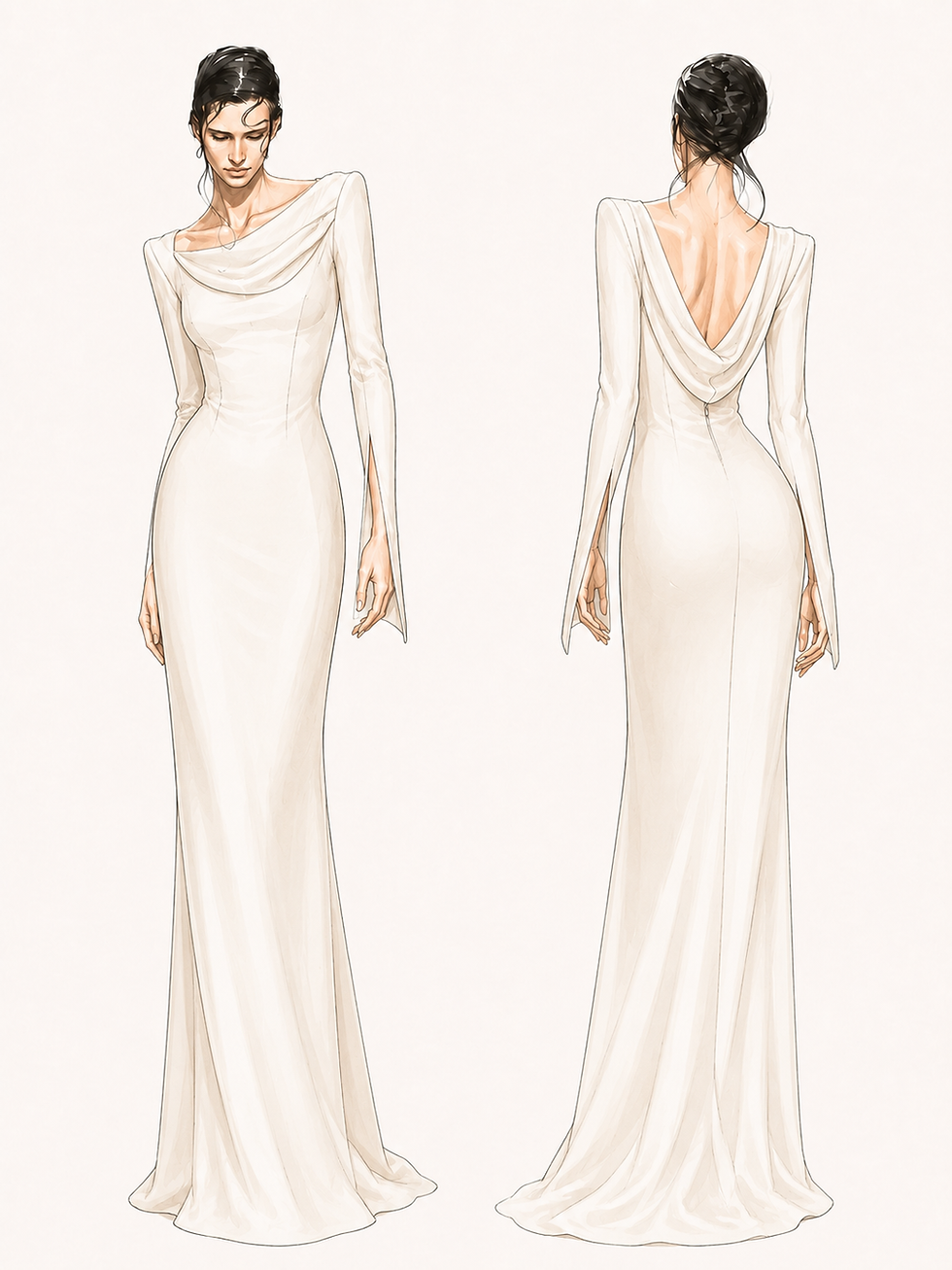
Design language: quiet confidence, warmth, restraint.
The construction decision: keeping a minimal long-sleeve gown clean when every pull line is visible.
Hestia represents the quietest interpretation of a Greek goddess wedding dress. Her gown does not need a dramatic cape, dense embroidery, or architectural overskirt.
That simplicity makes the construction less forgiving, not easier.
A minimal Hestia gown could use a softly folded neckline, long draped or split sleeves, a warm ivory crepe column, and a controlled cowl or folded detail at the back. The silhouette should appear calm and uninterrupted.
In a gown with no embellishment, every tension line becomes visible.
The sleeve weight can drag the neckline outward. A soft cowl back can pull the shoulder seam backward. Fabric can collect under the arm or collapse around the waist if the pattern relies on looseness instead of actual shaping.

Hestia: warm ivory crepe with a softly folded neckline and split sleeves. With no embellishment anywhere, every tension line is visible, so the shaping has to come from the pattern itself. The bust and waist are shaped through discreet seams rather than hidden beneath decoration, and an internal waist stay anchors the gown so the crepe appears to fall freely.

The cowl back and the sleeve weight pull in opposite directions. Left unstabilized, the sleeve drags the neckline outward while the cowl pulls the shoulder seam back. The shoulders and neckline are stabilized together so the fold holds its shape and the column stays uninterrupted.
The shoulders and neckline therefore need stabilization. The sleeve must be balanced so its weight hangs from the correct point rather than pulling against the bodice. An internal waist stay can keep the gown anchored while the outer crepe appears to fall freely. Bust and waist shaping should be distributed through discreet seams, darts, or internal construction rather than hidden beneath decoration.
Hestia is the proof that minimal design requires precision. There is nowhere for a weak pattern to hide.
Fabric direction: warm ivory silk crepe, folded neckline, long draped or split sleeves, clean column silhouette, internal waist stay, subtle back drape, no unnecessary embellishment.
Beyond the Goddesses: A Penelope-Inspired Wedding Dress

Penelope is not a goddess, and she should not be inaccurately placed among the six goddess designs.
She still belongs in this conversation because her story is inseparable from textile work.
Penelope delays her suitors through weaving and unweaving. Her intelligence is expressed through construction, repetition, patience, and control. A Penelope-inspired wedding dress should therefore be built around textile complexity rather than passive romance.
The design begins with an interlaced bodice: narrow ivory strips passing over and under each other, worked over a structured foundation, running through the bust and waist and continuing across the back. Beneath it, a draped hip releases into a fluid skirt and a soft train. The weaving is not applied to the gown. It is the gown's structure through the torso.
The central design question is:
How do you create a gown that appears restrained from a distance but reveals its intelligence through textile construction?
A woven or lattice panel cannot simply be placed anywhere on the gown. Its density changes the flexibility and weight of the fabric. If placed flat over the bust without shaping, it will distort or flatten the body beneath it, which is why the strips here are shaped and seamed over the bust rather than laid across it. At the waist, the interlacing has to retain enough give to allow breathing and sitting while still carrying the structural load. Where the panel meets the draped hip, the transition has to be engineered so the weight of the skirt hangs from the foundation rather than pulling on the woven strips themselves.
The construction carries its own story. Where the strips cross, the fabric holds. Where they open, the body shows. Density and openness are the same decision made repeatedly across the bodice, and that is what gives the panel its strength and its transparency at once. A structure held together by repetition is the closest a garment gets to the logic of a loom.
Penelope's gown should communicate intelligence before ornament.
Fabric direction: warm ivory, interlaced narrow-strip lattice bodice over a structured foundation, shaped through the bust and waist, sweetheart neckline with fine straps, draped hip, fluid skirt with a soft train, complex interlaced back panel, no floral lace.

How the Same Greek Goddess Design Changes for Different Bodies

The design reads the same. The pattern underneath is not.

The same Hera design at a size 2 to 4. The overfold is scaled to this torso length, the corset seams sit where the waist actually falls, and the draped hip is set to release into the skirt at the narrowest point of the body.

The same design, rebuilt for size 8-10. The overfold is set higher and shallower so it defines the waist instead of consuming the length between bust and hip. The corset is redrawn for a different bust volume and back depth, and the hip drape is repositioned so it falls from the widest point rather than pulling across it. The design reads the same. The pattern underneath is not.
This is the part generic inspiration roundups rarely address, and it is the part that matters most when a gown is being made for an individual bride.
Take Athena's one-shoulder bodice or Aphrodite's bias drape and place the same design on two bride-specific avatars. The design cannot remain technically identical and still produce the same visual result.
To preserve the design intent, the pattern and construction must change.
Drape depth must be adjusted over a fuller bust so the neckline does not gape, collapse, or become more revealing than intended.
Shoulder width and strap position must change so an asymmetric neckline lands correctly on the collarbone instead of sliding outward.
Internal support must respond to bust volume, back depth, and neckline shape rather than being scaled uniformly from a sample-size bodice.
Waist placement must move with torso length so an empire, natural, or dropped waist lands at the intended proportion.
Pleat width and spacing must change with the scale of the body. Pleats designed for a petite frame may disappear on a taller bride or create bulk on a shorter torso.
Skirt volume must be redistributed around hip projection so a bias or column skirt falls vertically instead of pulling across the widest point.
Slit length and position must reflect the bride's height, stride, and thigh proportion rather than being copied from a standard measurement.
Overfold depth must be adjusted so a peplos-inspired layer defines the waist instead of shortening the torso.
Sleeve and cape weight must be balanced against the bride's shoulder slope and bodice support.
Train length and attachment must respond to the bride's height and the gown's total weight.
This is why Studio RÉN builds a bride-specific avatar and creates a 3D preview before fabric is cut.
A Grecian silhouette lives or dies on how the drape sits on the individual body. Previewing the gown on the bride's own proportions makes it possible to identify a gaping neckline, compressed pleating, misplaced waist, twisting skirt, or unbalanced train while those issues can still be corrected in the digital pattern and design. You can preview your own gown on a bride-specific avatar before any fabric is cut.

The Technical Designer's View
The mistake I see with Grecian wedding dresses is treating "effortless" as a styling direction instead of an engineering result.
Effortless draping is difficult to build because you are asking cloth to appear unstructured while behaving in a controlled and repeatable way.
Each design in this article solves a different version of that problem.
Aphrodite's bias silk must move without stretching unevenly. Athena's one-shoulder bodice needs an asymmetric internal anchor. Hera's overfold has to hold its shape without overwhelming the torso. Artemis needs walking ease without losing a narrow line. Persephone's transparent layers rely on a corset that remains invisible. Hestia's sleeves and neckline have to stay balanced without embellishment hiding the tension. Penelope's textile detail must add complexity without making the gown rigid.
Fabric weight is therefore not a texture preference. It is a structural decision.
Vertical folds need enough mass to fall. Too little weight and the fabric collapses into cling. Too much weight and it overwhelms the frame or drags the bodice downward. A cape, sleeve, overskirt, or train changes how the entire gown is supported.
The bride's proportions are part of the same design decision.
A fold that looks elegant on one torso may compress another. A low drape that sits securely on a smaller bust may require a completely different internal foundation on a fuller bust. A wide pleat may create architectural clarity on a tall bride and consume the entire bodice of a petite one.
The objective is not to force every body into the same goddess gown.
It is to preserve the design language by rebuilding the gown correctly for the body wearing it.
FAQs
What Makes a Wedding Dress Look Grecian?
A Grecian wedding dress uses long vertical folds, controlled draping, asymmetric or softly folded necklines, and a column or flowing silhouette. The visual language comes from ancient draped garments, but a modern bridal version is usually built over a fitted internal foundation.
Which Fabrics Work Best for a Greek Goddess Wedding Dress?
Silk crepe, silk satin, matte crepe, silk faille, mikado, and silk tulle are strong choices for Greek goddess wedding dresses. Fluid silk crepe and satin work well for soft movement. Faille and mikado are better for held folds and architectural overfolds. The correct fabric depends on the required drape, support, silhouette, and the bride's proportions.
Can a Greek Goddess Wedding Dress Have Sleeves?
Yes. Draped or split sleeves suit a Grecian silhouette well, as seen in a Hestia-style design. The key is balancing the sleeve weight so it hangs from the correct point rather than dragging the neckline outward or pulling the shoulder seam back. In a minimal gown especially, the sleeve and neckline have to be stabilized together so the line stays clean.
Can a Grecian Wedding Dress Provide Bust Support?
Yes. Bust support can be built into an internal corset, stabilized cup structure, waist stay, or asymmetric inner bodice underneath the visible drape. The exterior fabric can remain soft while the hidden foundation carries the support.
Which Greek Goddess Wedding Dress Works Best for a Fuller Bust?
A structured design like Hera or Persephone tends to work best for a fuller bust, because both are built over a corseted or stabilized inner foundation that carries the support. A softly draped Aphrodite silhouette can also work well when the drape depth and internal cups are adjusted for bust volume. What matters more than the goddess is that the internal support and neckline are designed for the individual bust rather than scaled up from a sample size.
Can a Low-Back Greek Goddess Wedding Dress Still Be Supportive?
Yes, but the support must be planned around the reduced back coverage. A low-back design may require internal cups, side support, strategic boning, a waist stay, or concealed stabilization through the front and side bodice. The neckline and back depth must be designed together rather than treated as separate details.
Do Greek Goddess Wedding Dresses Work for Plus-Size Brides?
Yes. Greek goddess wedding dresses can work beautifully for plus-size brides when the drape depth, waist placement, pleat scale, skirt balance, and internal support are designed for the individual body. Simply enlarging a sample-size gown will not preserve the intended line.
What Is the Difference Between a Grecian Wedding Dress and an Empire-Waist Dress?
An empire waist is a seam or waistline positioned directly below the bust. A Grecian wedding dress is a broader design category defined by draping, folds, movement, and classical influence. Some Grecian gowns have empire waists, but others use natural, corseted, or dropped waistlines.
How Can a Greek Goddess Wedding Dress Look Modern Instead of Like a Costume?
A modern Greek goddess wedding dress translates classical draping into controlled bridal construction. It avoids literal toga wrapping, laurel crowns, theatrical gold fabric, and excessive historical styling. Clean patternmaking, restrained embellishment, hidden support, and body-specific proportion make the gown feel modern.
Can a One-Shoulder Grecian Wedding Dress Be Supportive?
Yes. A one-shoulder gown can be supported through an asymmetric internal foundation that anchors the covered side and stabilizes the open side separately. This prevents the bodice from rotating, gaping, or dropping under the uneven pull of the design.
Which Greek Goddess Is Best for a Minimalist Wedding Dress?
Hestia and Artemis provide the strongest starting points for a minimalist Greek goddess wedding dress. Hestia translates into quiet crepe columns, restrained sleeves, and subtle folds. Artemis works well for narrow silhouettes, high asymmetric necklines, clean slits, and detachable capes.
Is Penelope a Greek Goddess?
No. Penelope is a mortal queen in Greek mythology, not a goddess. She is included separately because her story is deeply connected to weaving, textile construction, patience, and transformation, which makes her especially relevant to bridal design.
Can Studio RÉN Preview a Draped Wedding Dress on My Body Before Production?
Yes. Studio RÉN creates a bride-specific avatar using the bride's measurements and develops a 3D gown preview before production. For a Grecian silhouette, this allows the drape, neckline, waist placement, pleat scale, and overall proportion to be reviewed before fabric is cut.
About the Author
Orly Lauren Doubinsky is a fashion technical designer with 15 years of experience in fit, patternmaking, garment construction, and product development, including senior manager roles across established global fashion labels. She is the founder of Studio RÉN and specializes in custom bridal design and bride-specific 3D gown previews that let brides see fit and silhouette before production begins. Learn more about Studio RÉN.
Studio RÉN is a custom bridal platform creating made-to-measure wedding dresses through bride-specific avatars, 3D gown previews, and custom design development. Brides can preview the fit, silhouette, and design direction of their gown before production begins.
Ready to See Your Own Greek Goddess Wedding Dress?
A goddess-inspired gown should not be copied from a sample-size image and adjusted after it reaches you. Studio RÉN develops the silhouette, internal support, drape direction, and proportion around your measurements, then previews the gown on your bride-specific avatar before production begins.

Takes about 3 to 5 minutes. You do not need every detail finalized, and Studio RÉN responds within three business days.
Made to your measurements
Previewed before fabric is cut
No in-person fittings
Available worldwide
The goddess and Penelope designs in this post are original Studio RÉN concepts inspired by figures from ancient Greek mythology, which is in the public domain. Studio RÉN is not affiliated with, endorsed by, or connected to any film, television, or other production based on those figures.


Comments