
Ordering a Custom Wedding Dress Online: What No One Tells You
Updated: May 23

What You'll Learn
How a fully online custom wedding dress process works - from first brief to final delivery - and what separates a reliable maker from one that isn't
The real timeline for a custom gown and why starting 9 to 12 months out matters more than most brides realize
The questions every bride should ask before committing to any custom maker online, and most never do
Ordering a custom wedding dress online - without stepping into a boutique, without a single in-person fitting - still makes most brides hesitate. That hesitation is reasonable. The questions behind it are legitimate. And many online bridal pages answer them vaguely, which makes it difficult for brides to understand what they are actually buying.
This post is an attempt to change that. If you are seriously considering a custom gown online, here is the honest, complete picture of what the process actually involves, what makes it work, and what makes it fail.
In This Guide:
What Does "Custom Wedding Dress Online" Actually Mean?
This is the question most brides do not ask - and should ask first.
"Custom" is one of the most overused words in bridal. It can mean anything from a fully original design built around your body and vision, to selecting from a dropdown of pre-existing styles and submitting your measurements to a size chart. Most online bridal brands offer the latter while marketing it as the former.
A genuinely custom wedding dress online means all four of the following:
The gown is designed specifically for you - not chosen from an existing collection
The pattern is built from your actual measurements, not from a standard size that approximates your body
You review and approve the design before production begins
You communicate directly with the designer or design team throughout the process
If any of those four elements are missing, what you are buying is not fully custom - regardless of what the brand calls it.
Studio RÉN was built by Orly Lauren Doubinsky, a senior technical design leader with over 15 years of experience in women's fit, garment construction, technical development, and global production. That background matters because online custom bridal is not only a design problem. It is a fit, proportion, construction, and production-control problem.
Custom vs Made-to-Measure vs Semi-Custom vs Made-to-Order: What Is the Difference?
These terms are used loosely across the bridal industry. Here is what each one actually means.
Term | What It Usually Means | What Brides Should Know |
Made-to-order | A gown is produced after purchase, often from an existing designer style | It may still be based on standard sizing |
Made-to-measure | A gown is adjusted or patterned around your measurements | More personal than standard sizing, but not always a fully original design |
Semi-custom | You choose from existing design options and personalise the details | Useful, but not the same as designing from scratch |
Fully custom | The gown is developed around your body, vision, and wedding from the beginning | Highest level of personalisation, but requires the most rigorous process |
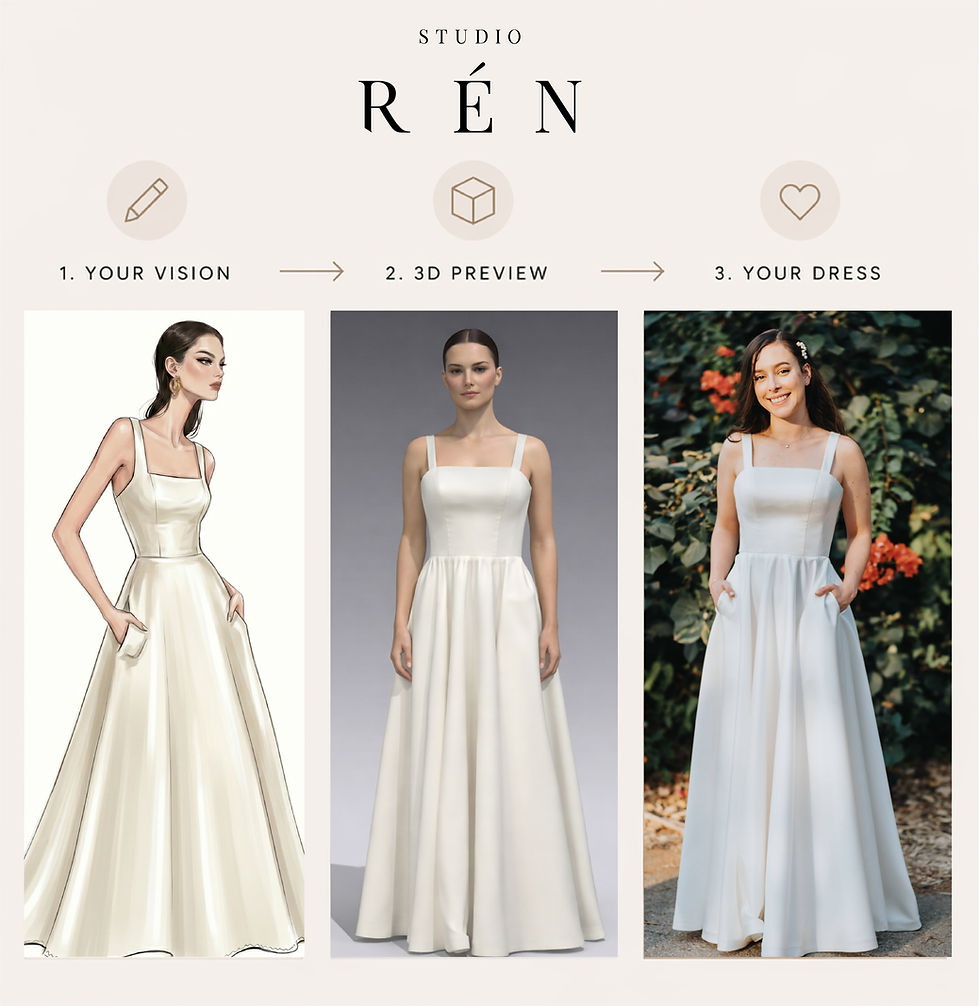
At Studio RÉN, the process is fully custom. Your gown does not exist in any form before you start the process. It is designed from scratch around your measurements, vision, and wedding context.
Is Ordering a Custom Wedding Dress Online Right for You?
Custom online bridal is not for every bride. Knowing this upfront saves time on both sides.
It may be right for you if:
You want a gown designed around your body and vision, not a standard boutique sample
You are comfortable communicating online and providing detailed design feedback
You can follow guided measurement instructions carefully
You want to review and approve the design direction before production begins
You are starting at least 9 to 12 months before your wedding
It may not be right for you if:
You need to physically try on many dresses before deciding
Your wedding is fewer than 9 months away
You want the lowest possible price more than process control
You are not willing to provide measurements, photos, or detailed design input
If you are unsure, contact the Studio RÉN team directly before submitting a preview request.
Can You Design a Wedding Dress Fully Online Without In-Person Fittings?
Yes. But understanding why requires understanding what traditional fittings were actually doing in the first place.
In a conventional bridal atelier, the dress is made first - then adjusted until it fits the bride. The fitting is a correction mechanism applied after the fact. A rigorous online process inverts that logic.
Measurements are taken upfront. The gown is designed digitally on your specific body proportions. Fit and structure are validated before production. The gown is only produced after your approval.
A boutique fitting process and a rigorous online custom process solve the same problem in different ways. Boutique fittings adjust the gown physically after it exists. A rigorous online process moves more decisions into the pre-production stage - using guided measurements, proportional review, and digital validation to reduce uncertainty before the gown is made.
This approach works reliably when three conditions are met:
Measurements are precise and collected with proper guidance
The design genuinely accounts for your body proportions - not just your size
Fit is tested and approved digitally before production begins
Without all three, the risk of a poor outcome is real. With all three, a fully online custom process is not only viable - for many brides, it is preferable because every major decision is resolved before the gown exists, not during stressful fittings afterward.

How Online Wedding Dress Measurements Work
Online measurements can be highly accurate when the collection process is properly guided.
The most common errors are pulling the tape too tight or too loose, measuring over the wrong undergarments, and ignoring posture and body alignment. A guided measurement process corrects for all of these.
The bigger distinction is not how measurements are taken but how they are used. Standard online sizing assigns a closest-match size from a pre-existing chart. True custom construction uses your measurements to build the pattern from scratch. A 38-inch bust on one body is structurally different from a 38-inch bust on another - the distribution of weight, torso length, shoulder width, and hip proportion all affect how a bodice sits. A size chart ignores that. A custom pattern accounts for it.
What Reliable Online Measurement Guidance Should Include
What undergarments to wear while measuring
Whether to measure yourself or ask someone to help
Clear instructions for tape tension at each measurement point
Guidance on posture and standing position
A way to review or clarify unusual proportions before production
A process for flagging fit concerns early in the design phase
If a maker's measurement instructions are a single paragraph or a generic size chart, they are not running a true custom process.
Why Photos Matter in the Online Custom Process

Measurements tell part of the story. They do not explain posture, shoulder slope, torso length relative to hip position, bust placement, or how a bride naturally carries herself. That is why a rigorous online custom process typically requests photos as part of the design and proportion review.
These photos should be used exclusively for gown development, avatar creation, and fit analysis. A trustworthy maker explains clearly how photos are used, who reviews them, and whether they are ever shared publicly. Ask before you submit.
At Studio RÉN, photos submitted as part of the design process are used solely for the bride's gown development and are never shared without consent.
What a 3D Wedding Dress Preview Actually Shows You
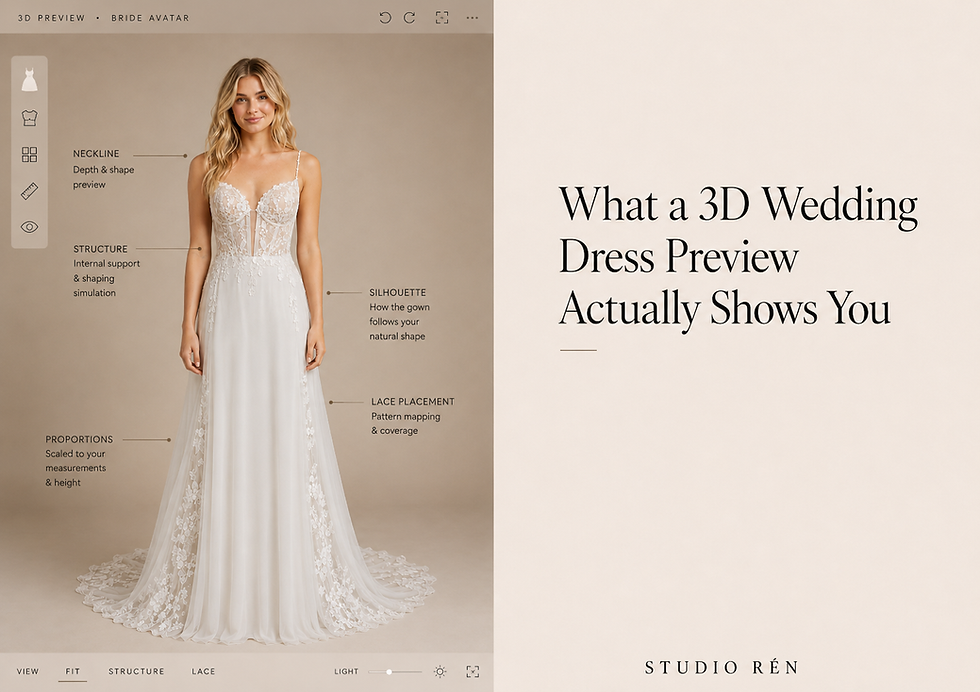
A 3D wedding dress preview is a digital simulation of your gown rendered on an avatar built from your submitted measurements and proportions. Before a single piece of fabric is cut, you see the silhouette, neckline, structure, lace placement, and overall design direction of your dress on a body that reflects yours - not a standard model.
This is where the work of traditional bridal fittings happens in the Studio RÉN process. Design adjustments, proportion decisions, and structural changes all happen at the digital stage, when they are easy to make. By the time production begins, the design has been reviewed and approved. The goal is to catch proportion and design issues before the gown reaches production, not after.
At Studio RÉN, no gown goes into production without the bride's full approval of the 3D simulation.
How Long Does a Custom Wedding Dress Take to Make?
Stage | Estimated Timing | What Happens |
Design development | 1 to 3 months | Brief, references, silhouette direction, fabric, design details |
3D preview and validation | 1 to 2 weeks | Gown reviewed on bride-specific avatar, adjustments made, final approval given |
Production | 6 to 9 months | Pattern-making, fabric sourcing, cutting, construction, embellishment |
Delivery | 1 to 3 weeks | Shipping and final handling |
The full process takes 9 to 12 months from start to delivery.
For most brides, the safest start point is 9 to 12 months before the wedding. If the gown is heavily embellished or the design direction is still unclear, starting at 12 months is safer.
This is where many online brands mislead brides. When you see brands advertising custom gowns in 2 to 3 months, they are working from semi-custom templates, not building from scratch. A true made-to-measure gown built around a fully original design takes longer - and that time is what the precision requires.
For a fully custom Studio RÉN gown, 9 months is the safest latest starting point. If your wedding is sooner, contact the team directly so we can assess whether a simplified or compressed path is realistic for your situation.
Read: The Ultimate Wedding Planning Checklist and Timeline for Brides Designing a Custom Wedding Dress

The Real Risks of Ordering a Custom Wedding Dress Online
Ordering online is not the risk. Ordering from a maker without proper fit validation, transparent timelines, and structured design communication is the risk - and that problem exists in physical boutiques too.
Risk | Why It Happens | How to Reduce It |
Poor fit | Measurements used only for size selection, not custom pattern development | Use guided measurements with custom pattern construction |
Wrong silhouette | Bride approves an idea without seeing it on her proportions | Review a 3D preview or detailed design visualization before production |
Timeline pressure | Production begins too late | Start 9 to 12 months before the wedding |
Miscommunication | Maker does not document design decisions clearly | Require written design approval before production begins |
Low-quality construction | Process treated like e-commerce, not bridal production | Ask who designs, patterns, and produces the gown |
No correction policy | The finished gown does not match expectations | Ask in writing what happens if the gown differs from the approved design |
What Happens If the Dress Needs Alterations?
Minor post-delivery adjustments - hem length, strap shortening, small waist refinements - are a normal part of any bridal experience, whether the gown came from a boutique or was made online. They are manageable with any local seamstress and should be expected as part of the process.
Major fit issues - such as serious bust support problems, severe proportion mismatch, or a silhouette that does not reflect the approved design - usually point to a weakness earlier in the process. That is why fit validation, clear approval, and proper construction planning matter before production begins.
When a gown has been through a rigorous 3D validation and design approval stage, major fit issues are far less likely. The validation stage is specifically designed to catch proportion and construction concerns before the gown is made.
What If Your Body Changes Before the Wedding?
Minor body changes are a normal part of any bridal timeline. A well-made custom gown includes seam allowances that accommodate small fluctuations. Significant changes in either direction may require standard post-delivery alterations, which any local seamstress can handle.
The advantage of a made-to-measure gown is that it starts from your actual body, not a standard size. That means the alteration margin needed is usually smaller than with a boutique dress adjusted from a standard pattern.
If you are planning significant body changes between now and your wedding, raise this during the design phase - not after production has started. The design stage is the right time to account for it.
Questions to Ask Before Choosing Any Maker
These are the questions that separate a rigorous custom process from a semi-custom one presented as fully custom.
Does the gown start from my measurements or from a standard size? If the answer involves the phrase "closest size" at any point, the gown is not fully custom.
Will I approve a design before any fabric is cut? The only acceptable answer is yes. Anything else means you are committing to a finished product you have never seen.
What does the design validation stage actually show me? Ask for specifics. Silhouette, neckline, proportion, lace placement, structure - all of these should be visible and adjustable before production.
Who is the designer, and what are their credentials? At a genuine custom atelier, the designer has a name and a background. If no designer is named, the process is likely more automated than the brand implies.
What is the production timeline, stage by stage? A maker who knows their process can tell you this clearly.
What happens if the finished gown does not match the approved design? This should be stated clearly in writing before you pay a deposit.
[Download the Free Custom Wedding Dress Online Checklist - know what to ask before choosing a maker, what to prepare before your consultation, and how to avoid the most common online custom gown mistakes]
Frequently Asked Questions
Can you design a custom wedding dress online without in-person fittings? Yes. A reliable online custom process replaces traditional fittings by collecting precise measurements upfront, designing the gown digitally on your proportions, and validating fit through a 3D simulation before any fabric is cut. When all three elements are in place, the process is not only viable - it is often more controlled than a boutique experience.
Is a custom wedding dress online the same as made-to-measure? No. Made-to-measure usually means the gown is adjusted or patterned around your measurements, often starting from an existing design. Fully custom means the design itself is developed around your body, vision, and wedding from the beginning. Some brands use these terms interchangeably, so always ask whether the gown starts from a standard style or from an original design process.
How long does a custom wedding dress take to make online? A true made-to-measure custom gown takes 9 to 12 months from start to delivery, including the design phase, 3D validation, production, and shipping. Brands advertising custom gowns in 2 to 3 months are typically working from semi-custom templates. At Studio RÉN, we recommend starting 9 to 12 months before your wedding date.
How accurate are online wedding dress measurements? Highly accurate when the process is properly guided. The common errors - tape tension, wrong undergarments, poor posture - are all preventable with structured instructions. The more important question is not how measurements are taken but whether the maker uses them to build a custom pattern or simply to assign a standard size.
What is a 3D wedding dress preview? A digital simulation of your gown rendered on an avatar built from your submitted measurements and proportions. At Studio RÉN, every bride reviews her gown in 3D before production begins. Silhouette, neckline, proportion, and design details are confirmed and adjusted at this stage. No gown goes into production without the bride's full approval.
Do I still need alterations after ordering a custom wedding dress online? Possibly. Minor alterations - hem, strap length, small fit refinements - are normal with almost any bridal gown. A strong custom process reduces the need for major alterations, but minor post-delivery adjustments are a standard part of any bridal experience and should be expected.
What happens if a custom wedding dress doesn't fit when it arrives? Minor adjustments are handled by a local seamstress. Major fit issues - such as structural problems or a silhouette that does not match the approved design - point to a process breakdown earlier in the development stage. The 3D validation step at Studio RÉN is specifically designed to prevent major fit surprises.
How do I know if an online custom wedding dress maker is legitimate? Look for a clear named process, documented designer credentials, guided measurement instructions, written design approval before production, transparent stage-by-stage timelines, real examples of finished gowns on real brides, and a written policy for what happens if the gown differs from the approved design.
What should I prepare before starting a custom wedding dress online? Your wedding date, venue, budget range, inspiration images, your favourite and least favourite silhouettes, any fit concerns, and specific details you know you want included or avoided. The clearer your brief, the faster and more accurately your design phase will move.
What if my body changes between ordering and receiving my custom gown? Minor changes are accommodated by seam allowances built into the construction. Significant changes may require standard local alterations after delivery. Because a custom gown starts from your actual body rather than a standard size, the alteration margin needed is usually smaller than with a boutique dress.
Studio RÉN is a custom bridal platform creating made-to-measure wedding dresses through bride-specific avatars, 3D gown previews, and custom design development. Brides can preview the fit, silhouette, and design direction of their gown before production begins.
A fully bespoke gown, built around your body, validated before a single stitch is made.


Comments