
Custom vs. Semi-Custom vs. Made-to-Measure vs. Made-to-Order Wedding Dresses

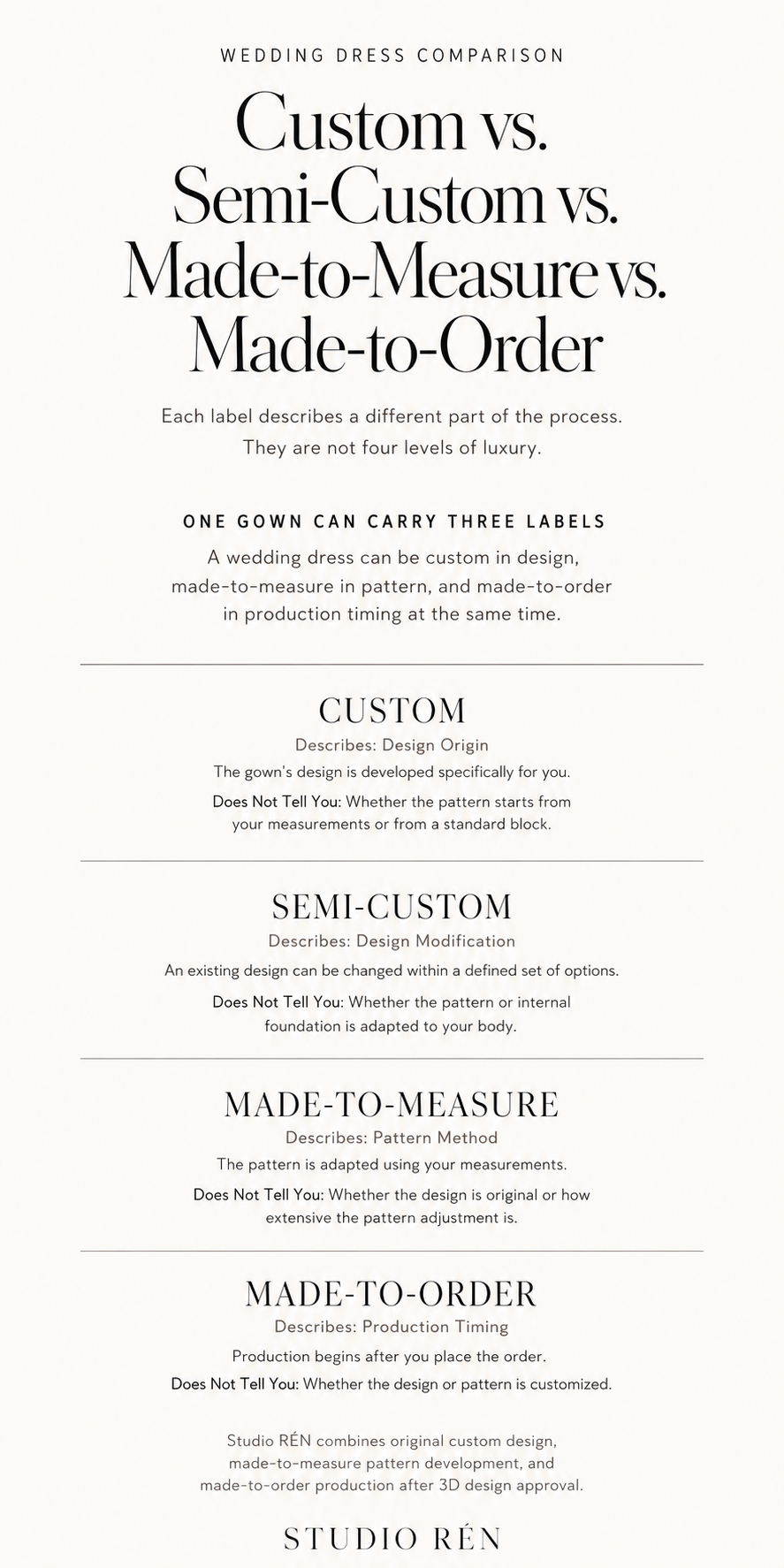
Custom, semi-custom, made-to-measure, and made-to-order are not four steps on one bridal ladder. They describe different parts of the process, and one wedding dress can carry more than one label at the same time.
Made-to-order tells you when production begins. Semi-custom and custom describe how much of the design is modified or developed. Made-to-measure describes how the pattern is adapted to your body. A gown can be custom, made-to-measure, and made-to-order at the same time.
So the useful question is not which label sounds most luxurious. It is what actually changes in the design, the pattern, the internal structure, the measurements, and the approval process before fabric is cut.
What You’ll Learn
What custom, semi-custom, made-to-measure, and made-to-order actually mean, and what each term leaves unanswered
How to recognize the five common ways wedding dresses are designed, patterned, and produced, regardless of how a bridal house labels them
Which questions to ask before paying a deposit, and what a clear, credible answer should include
In This Article
Written by Orly Lauren Doubinsky
Orly Lauren Doubinsky is the founder of Studio RÉN and a women's technical designer with 15 years of experience in fit, construction, and digital product development. Her background includes senior management technical design roles at Banana Republic and Marine Layer, consulting for Derek Lam 10 Crosby, and internships at Marchesa and Alexander Wang.
What Each Label Actually Tells You
Each of these words primarily describes one dimension of the process and does not reliably answer the others. That is the whole reason they cause confusion.
Label | What It Tells You | What It Does Not Reliably Tell You |
Made-to-order | Production begins after you order. No finished gown is sitting in stock. | Whether the pattern is standard or adapted to you. Whether the design was changed at all. |
Semi-custom | An existing design may be modified within a defined list of permitted changes. | Whether the pattern is adapted to your measurements. Whether the internal structure changes with the design. |
Made-to-measure | The pattern is adapted to your measurements. | Whether the design is original or an existing style. How far the adaptation goes. |
Custom | The design is developed for you. | Whether the pattern starts from your measurements or from a standard block. |
Bespoke | In Savile Row tailoring, an individually cut pattern developed through a series of fittings. | How a bridal house is using the term, since bridal usage is far less consistent. |
The Savile Row Bespoke Association defines bespoke precisely: a pattern made specifically for the customer, cut by an individual, requiring a series of fittings. Its definition of made-to-measure is deliberately broader, a garment made to a customer's individual requirements to some extent. Those are careful definitions, and the breadth of the second one is the point. Even in the discipline where these words originate, made-to-measure describes a range rather than a fixed standard. Bridal businesses use both terms less consistently still.
So the label is a starting point, not an answer. Ask how the pattern is created, which fittings or previews are included, and what is approved before cutting.
Viewed together, the overlap becomes obvious.
The Four Dimensions That Decide the Outcome
1. Pattern Method: A Standard Graded Pattern, or One Adjusted to You

A size chart is not a list of measurements. It is a set of proportional assumptions. It assumes that a given bust circumference arrives with a particular bust point height, torso length, shoulder slope, waist level, and hip depth.
Grading, the process of producing a size range from one base pattern, moves pattern points by fixed increments between sizes. It scales that whole set of assumptions up and down together.
Real bodies do not vary in those increments.
Take two brides with an identical bust circumference. On one, the bust point sits higher and the torso is short. On the other, the bust point sits lower and the torso is about 1.5 inches (4 cm) longer. If both are assigned the same bodice size, the graded pattern places the cup apex, the underbust seam, and the waist seam in the same pattern positions for both. On the first bride those seams land correctly. On the second, the cup apex sits above her actual apex, the underbust seam presses across the fullest part of her bust instead of under it, the waist seam sits above her natural waist, and the neckline stands away from her chest because the whole bodice is being pulled upward.
Nothing is defective in that dress. It was cut for a set of proportions she does not have.
This is why the measurements that matter go well beyond bust, waist, and hips. Circumferences tell you how much room the pattern needs. Vertical landmarks tell you where the structure must sit.
The production decision this changes: whether bust point, underbust, waist seam, hip level, and hem are placed from your measurements or from the chart's assumptions. That happens before anything is cut and it is expensive to reverse.
2. Design Origin: An Existing Style, or Developed for You

When a style is modified rather than developed, you inherit its engineering. The seam lines were drawn to hold that specific neckline. The boning lengths were set for that bodice height. The skirt panels were drafted for that fabric weight and hem circumference. The foundation was built to carry the load that design creates.
Some modifications sit comfortably inside that engineering. Some do not.
Raising a neckline by half an inch on a strapless bodice may be a local edge adjustment. Removing the straps from a design engineered with straps carrying part of the load is a structural change, because the weight the straps were taking has to be transferred somewhere else, usually into the cups, the internal seams, and the waist stay. If the foundation is not re-patterned, the neckline can be left carrying a load it was never drafted to hold, and it may roll, gape, or slide during the day.
A fabric substitution belongs in the same category. A bodice drafted for crepe behaves differently in mikado, tulle, or heavy duchesse satin. Weight changes how much load the boning and waist stay carry. Drape changes how the skirt panels fall and where the hem sits. The pattern is unchanged, but the garment is not the same garment.
A house may quote both a neckline edge change and a strap removal as "a simple modification." One of them usually is. The other is a rebuild of the internal support system.
The production decision this changes: whether the internal foundation is re-patterned when the visible design changes, or whether the existing foundation is kept and only the outer layer is altered.
3. Production Timing: In Stock, or Made After You Order
This is the dimension made-to-order describes, and it is the least informative of the four. It tells you no finished gown is waiting in a warehouse. It tells you nothing about fit.
Some made-to-order houses offer partial measurement options: a custom hollow-to-hem length, a choice of cup size, an extended size range. Those are genuine adjustments, but only on the axes offered. Choosing your hem length does not move the waist seam or the bust point.
4. Approval Method: What Exists in Writing Before Fabric Is Cut
Each configuration gives you a different reference before purchase or production: the actual gown, a sample you may be able to try on, campaign imagery, written modification details, a measurement record, or a bride-specific design visualization.
That reference does not decide who is liable if something goes wrong. Your contract and its remedy terms do that.
What it decides is whether there is anything specific to point at. If the only shared reference is a phone call, the conversation after delivery is two different memories of the same sentence. If you approved a rendered image of your design on your proportions, the conversation is about a documented decision.
The production decision this changes: what counts as agreed. That record becomes the shared reference for later quality, correction, or remedy discussions.
Five Configurations You Are Most Likely to Be Offered
Whatever a house calls its process, it will be some combination of the four dimensions above. These are the combinations that occur most often in practice.
1. Off the Rack
The gown exists. You buy the sample or a stocked size and take it away.
Pattern: standard, graded. Design: unchanged. Production: already complete.
The advantages here are real and specific. You can see and handle the fabric, inspect the construction, try the garment on, and, when the gown is in stock, take it home immediately. No other configuration offers that.
Availability may be immediate. Alteration time is separate, and how much you need depends on how closely the sample or stocked size fits your proportions. Budget for alterations as a distinct line item rather than assuming the sticker price is the total.
2. Standard-Size Made-to-Order
An existing design, produced after you order, cut to the house size chart.
Pattern: standard, graded, sometimes with a length or cup option. Design: unchanged. Production: begins on order. Approval may be based on a boutique sample you try on, a showroom sample, or imagery of the design.
Alterations: moderate to significant, depending on how closely your proportions match the chart.
This is the configuration most often described in language that sounds custom. Producing a garment after payment is a supply chain decision, not a fit decision.
3. Semi-Custom Made-to-Order
An existing design with permitted modifications, produced after you order, usually still cut to a standard size.
Commonly permitted: neckline shape, added or removed sleeves and straps, train length, fabric or lace substitution, beading density, back detail and closure, lining and color.
Commonly unchanged: the base block and its grading, the internal foundation, the bodice seam architecture, the skirt panel drafting.
The question worth asking here is precise, and the answer separates serious houses from the rest: if I change this element, is the internal foundation re-patterned, or does the existing foundation stay as it is?
4. Made-to-Measure Existing Design
An existing design, with the house pattern adjusted to your measurements. How far that adjustment goes varies by house, which is why the label alone is not enough.
In a thorough made-to-measure process, your vertical landmarks move onto the pattern: torso length, waist level, bust point, strap length, back height, hem, train drop. Circumferences are built in with the intended ease rather than taken in afterward at the side seams. That distinction matters more than it sounds, because taking a bodice in after the fact can disturb the balance of adjacent seams and move the boning channels relative to your body.
What this does not change is the design. If the neckline width is wrong for your shoulders, made-to-measure gives you that neckline in your size.
It also relocates the point of failure. Once the pattern follows your numbers, measurement accuracy and the patternmaker's interpretation of those numbers become the critical constraints, which is why a serious remote process runs a defined measurement protocol rather than a form asking for three numbers.
A production decision worth asking about: seam allowance strategy. Some makers cut specific seams with additional allowance so a later adjustment is possible without rebuilding the bodice. This is a maker's practice rather than a feature of the label, it is decided before cutting, and it cannot be added afterward.

5. Fully Custom and Made-to-Measure Wedding Dress

The design is developed for you and the pattern is drafted or substantially re-engineered around your body, your fabric, and that specific design. Internal structure is built for your bust volume, torso length, and posture. Cut direction, straight grain or bias, is a deliberate decision about how the fabric will move on you.
This configuration is delivered two ways. A traditional atelier develops the design through sketches, draping, and reference samples, drafts the pattern, and refines it through a toile and a series of physical fittings. A remote studio develops the design, drafts the pattern from a measurement protocol, and reviews proportion and placement on a bride-specific avatar before production. Both are fully custom and made-to-measure. They differ in which risks they control and when, which is the subject of the next section.
An honest limitation: custom is not automatically a better fit than well-executed made-to-measure. Both can produce excellent fit. Custom becomes the right answer when the design itself needs to be different, or when the structural problem is one an existing foundation was never drafted to solve. If an existing style is genuinely right for you and only needs adapting to your body, configuration 4 is more efficient and you should not pay for design development you do not need.
If You Need an Original Gown Developed Around Your Proportions
Studio RÉN builds a bride-specific avatar from your measurements and produces a 3D preview of your design, so silhouette, proportion, and placement are reviewed and approved before production begins.

How Physical Fittings and 3D Previews Control Different Risks

Traditional bespoke and some fully custom atelier processes use a toile, a test garment in inexpensive fabric, followed by one or more physical fittings. The Savile Row definition of bespoke builds that series of fittings into the term itself. How many fittings a given house includes varies, which is the same reason the label alone is not enough.
A fully remote process does not rely on repeated in-person fittings, and a 3D preview is not a digital version of one. The two controls address different risks.
A toile tests pattern balance, placement, ease, and physical fit on the actual body. What it does not fully reproduce is the behavior of the final fabric, unless the test material closely matches its weight, stretch, and drape. That is why makers often toile in a substitute and still expect adjustment once the real cloth is cut.
A 3D preview tests design and proportion. It shows silhouette, proportion, placement, volume, neckline depth and width relative to your frame, waist level, skirt fullness, train length, and overall balance. It produces a documented approval of the design before production begins.
What a 3D preview cannot show: exact hand feel, precise fabric behavior in every movement and lighting condition, or the final millimeter of physical fit. It is not a physical fitting and it does not guarantee that no alterations will be needed.
That is a real trade. A remote process moves design and proportion review earliest, when correction is cheapest, and accepts that physical confirmation happens on delivery rather than mid-production. A traditional process validates physical fit progressively, while some aspects of the final fabric, embellishment, and finish may still need to be inferred until later stages. Neither eliminates risk. They front-load different parts of it.
Any process presenting a preview as a fit guarantee is overselling it.
Alterations, Cost, and Timeline: Honest Expectations
Will It Still Need Alterations?
Often, yes. No configuration guarantees no alterations, and no maker in any format should promise zero alterations. What well-executed made-to-measure and custom production should do is reduce how often major corrections are needed and how severe they are.
Common possible refinements include: hem leveled to the final shoe, strap length, a small take-in at the waist or side seam, bustle attachment and positioning, closure adjustment. Not every gown needs all of them.
Not normal: rebuilding the bodice, moving the waist seam, re-cutting the neckline or armhole, repositioning cups or boning. Work at that scale points to a failure somewhere in the chain. It may be the measurements, the pattern, or the construction itself, and a substantial body change after the pattern was made can produce the same result. The maker should investigate the problem and explain the most likely cause.
Alterations become more likely if your shoes, undergarments, or measurements change after the measurement stage.
A serious process captures shoe height and undergarment choice as part of the measurement protocol precisely so those variables are fixed before the pattern is made. If you change them afterward, you have changed an input the pattern was built on.

What You Are Actually Paying For
Price tracks pattern labor, whether a toile or sample is made, how many approval cycles are included, fabric sourcing and yardage, construction time, and whether the maker prices in remake risk.
One point that surprises many brides: semi-custom can cost more than made-to-measure. Some houses price modifications as add-ons on top of a retail style, so three changes to an existing gown can exceed the price of a house that includes pattern adjustment in its base. Price does not move in a straight line with how custom something is.
Compare total cost, not sticker price. An off-the-rack gown at an attractive price plus significant structural alterations can land close to a made-to-measure gown that needed almost none. What actually changes the price of a custom wedding dress breaks the drivers down properly.
Timeline
Two different numbers get confused here. Lead time is how long a route takes to produce. When to start adds decision time, revisions, shipping, and the alteration window before the wedding. A route with a short lead time can still need a long runway.
Off the rack is the fastest, a custom gown is the longest, and complex construction extends it further. The alteration window at the end is not padding. It absorbs body change and final decisions, and it is the first thing a compressed schedule eliminates.
The full stage-by-stage timeline has the breakdown.
Who Each Configuration Suits, and Who Should Not Choose Custom
Off the rack or standard-size made-to-order suits you if: you love an existing design as it is, your proportions sit reasonably close to the size chart, and you have both access to a skilled bridal alterations specialist and a budget for that work.
Semi-custom suits you if: a specific style is nearly right and you need one or two defined changes, and the house can tell you clearly whether those changes are cosmetic or structural.
Made-to-measure suits you if: the design is right but standard sizing fails you vertically. Long or short torso, a large bust with a smaller underbust, tall or petite proportions, or a significant spread between your bust, waist, and hip sizes.
Fully custom suits you if: the design you want does not exist, or the fit problem is structural, or you want to approve proportion and placement before production begins.
Custom is the wrong choice if:
You need the lowest possible price. Custom is not the cheapest route and should not be sold as one.
Your runway is very short. Compressing design development is where custom goes wrong.
You cannot make design decisions without physically trying garments on. Some brides need to feel a silhouette before they can commit, and no preview replaces that.
Your measurements are likely to change substantially and you are not willing to plan a remeasure point into the schedule.
Eight Questions to Ask Before You Pay a Deposit
Does my pattern start from a standard size or from my measurements, and which measurements do you use?
Is this design an existing style or is it being developed for me?
If I change the neckline, straps, or fabric, is the internal foundation re-patterned, or does the existing foundation stay?
What exactly will I approve in writing, and in what form, before fabric is cut?
What alterations do you expect at the end, who performs them, and who pays?
What happens if my measurements change before the wedding? Is there a remeasure point in the schedule?
If the finished gown does not match what I approved, what is the remedy, and where is it written?
What is the fabric, what is its weight, and will I see a physical swatch before it is cut?
A maker who answers all eight clearly, specifically, and in writing is describing a process you can evaluate before paying a deposit. A confident verbal answer is not the same thing. The full set of questions to ask before ordering a custom wedding dress online goes deeper into contracts and production responsibility.
A Technical Designer's View
In ready-to-wear, fit is developed on a base size and graded outward. Each graded size range inherits the proportional assumptions of its approved base size, and the size chart carries those assumptions into every garment produced from it. That system is efficient, and for most clothing the tolerance is wide enough that it works.
Bridal has far less tolerance for that proportional mismatch. One body, one garment, one day, and a design with internal structure that has to hold a specific shape for twelve hours through movement, heat, sitting, and dancing.
A recurring fit failure in structured gowns is not circumference but vertical placement. The dress closes. The bride can breathe. The bust apex, the underbust seam, and the waist seam are simply in the wrong places for her torso, and the symptoms follow from that: the gaping neckline, the fabric riding up, the horizontal fold under the bust.
Circumference usually has some correction room inside the seam allowance. Vertical placement becomes substantially harder and more expensive to correct once the cups, boning, neckline, and waist seam have been constructed around it. That distinction separates these configurations more reliably than any label or price bracket does.
FAQ
Is Made-to-Measure the Same as Custom? No, and a gown can be both. Made-to-measure describes how the pattern is adapted to your measurements. Custom describes how much of the design is developed for you. A made-to-measure gown can use an entirely existing design, and a custom design can still be cut from a standard block. Ask about the pattern and the design separately.
Is Made-to-Order the Same as Custom? No. Made-to-order means production begins after your order rather than from stock. It describes inventory timing, not fit or design. A gown can be made-to-order and cut to a standard size with no adjustment to your body at all.
Does a Made-to-Measure Wedding Dress Still Need Alterations? Often yes, and minor local work is normal: hem to the final shoe, strap length, a small waist take-in, bustle attachment. No process guarantees only minor alterations. What made-to-measure and custom production should do is reduce how often major corrections are needed. Structural work at the end, such as moving a waist seam or repositioning cups, points to a problem in the measurements, the pattern, the construction, or a significant body change after the pattern was made.
Is Bespoke Different From Custom for Wedding Dresses? In Savile Row tailoring, bespoke refers to an individually cut pattern developed through a series of fittings. Bridal businesses use the term less consistently, so the label alone is not enough. Ask how the pattern is created, which fittings or previews are included, and what is approved before cutting.
Which Option Is Cheapest? Off the rack usually has the lowest sticker price, but total cost is what matters. Add the alteration budget, and add the cost of structural alterations if your proportions differ from the size chart. Semi-custom can exceed made-to-measure when a house prices each modification as an add-on to a retail style.
About Studio RÉN

Studio RÉN is a custom bridal platform creating made-to-measure wedding dresses through bride-specific avatars, 3D gown previews, and custom design development. Brides can preview the fit, silhouette, and design direction of their gown before production begins.
If You Need a Fully Custom Gown
Studio RÉN builds a bride-specific avatar from your measurements and produces a 3D preview of your design, so silhouette, proportion, and placement are reviewed and approved before production begins.


Comments