
Wedding Dress Boning and Bust Support: How to Tell If a Gown Is Built Properly

A properly built wedding dress does not use the same internal structure in every design. What matters is whether the support system matches the neckline, the fabric weight, the bust volume, the torso length, and the movement the gown has to survive. A soft bias-cut gown with straps may be built properly with almost none of the hardware a structured strapless bodice depends on. That strapless bodice may need some combination of correctly placed boning, an internal waist stay, stabilized neckline edges, shaped cups, and an inner corselet.
A wedding dress lives or dies on the parts you cannot see.
The lace, the satin, and the neckline you fell in love with all sit on top of an internal system that decides whether the gown holds its position or slowly gives way over the night. Two dresses can look identical on the hanger and behave completely differently the moment a real body moves inside them. The difference is the engineering underneath, and the point of this post is that you can learn to check for it.
First, the bride-facing part: what the support systems are, which designs need which, and the checks you can do yourself. Then, from more than a decade in technical design and garment construction, how those systems are actually built and why thickness is not proof of support.
What You'll Learn
Which internal support systems exist, what each one does, and why the right set depends on the design rather than a fixed formula.
The checks you can do yourself that reveal whether a gown's structure matches its design, including a movement test that catches what the mirror misses.
Why bust volume and torso length change what support requires, and how structure gets planned before anything is cut.
Table of Contents
Written by Orly Lauren Doubinsky.
Why Structure Is the Part That Fails Quietly
A weak fabric choice shows up immediately. A weak structure shows up at the reception.
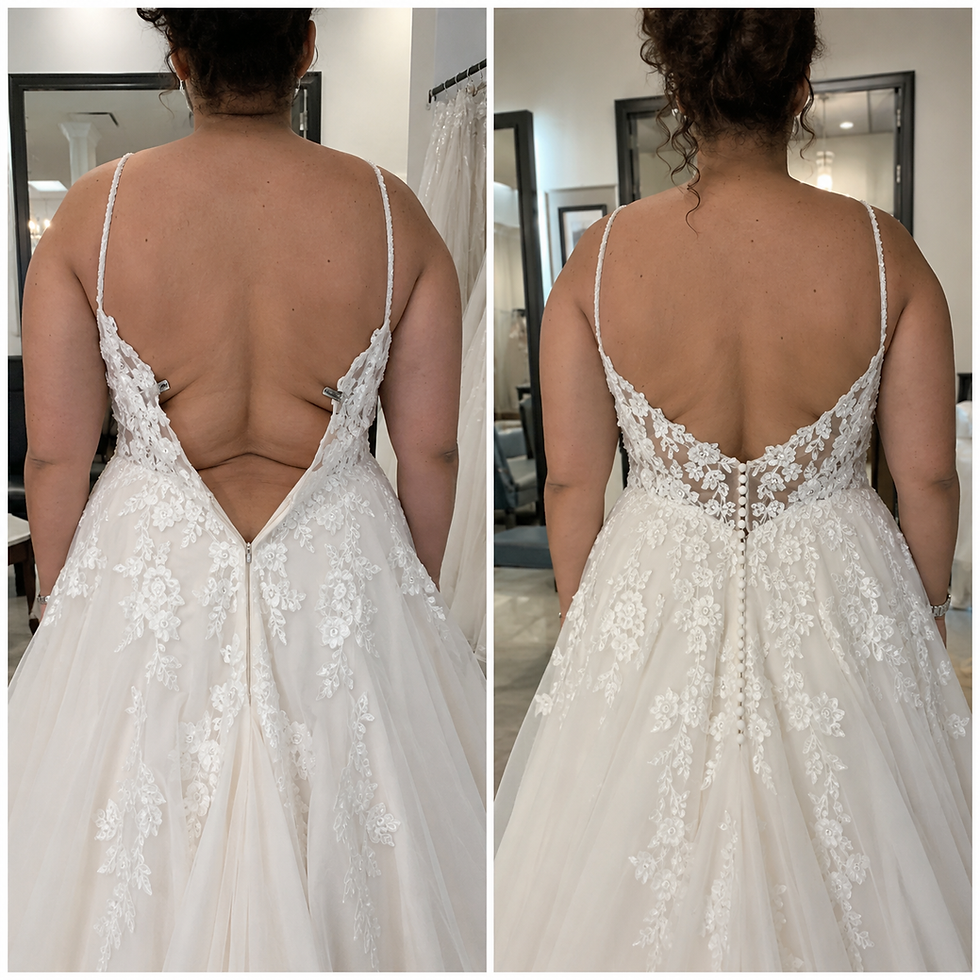
On the hanger, and even in the first few minutes of wear, a gown whose support does not match its design can look flawless. The failure arrives later: the neckline that starts to gap when you lift your arms, the bodice that rotates as you dance, the strapless top that needs a discreet tug every twenty minutes, the waist seam that creases and rides up once you sit. Those symptoms can come from pattern balance, fit, fabric behavior, sewing, or internal construction. What they share is that the gown is not performing correctly on the body.
This matters most exactly where the structure has to work hardest: a strapless or low-back neckline, a heavy skirt, a fuller bust, a longer or shorter torso than the standard block. Those are the cases where a generic build is most likely to come up short, and an under-built gown does not announce itself. It waits.
The Support Systems a Structured Bodice May Need

There is no fixed checklist that every gown must contain. There is a toolkit, and a properly built gown uses the tools its design requires. These are the main ones.
Boning. Strips set into channels inside the bodice that help it resist folding, caving at the sides, and rotating around the body. Boning holds panel shape. It does not, by itself, hold a whole gown up.
A waist stay. A separate band, usually grosgrain ribbon, anchored at the natural waist and fastened independently of the main closure. It transfers the weight of a heavy skirt or gown to the waist so that weight is not hanging from the zipper. In a heavy or strapless design, its presence is a good sign the maker thought about where the load goes. It is not a universal quality certificate: a badly patterned gown can contain a waist stay, and a beautifully built lightweight gown may not need one.
Built-in bust support. Anything from shaped cups to a full inner corselet, engineered into the gown so the bust is supported from inside rather than by a separate bra or by the fabric alone. What this needs to be depends heavily on the bust and the design, which gets its own section below.

Neckline stabilization. The least visible system and one of the most important. Stay tape, elastic, gripper elastic, interfacing, and underlining along the top edge are what keep a neckline sitting against the body instead of standing away from it. A strapless edge that holds all night is stabilized, not just boned.
Engineered inner layers. Coutil, stable woven underlining, canvas, power mesh, and interfacing are structural materials built into the foundation. They are different in kind from a decorative lining, which is the distinction the "thickness" section below is about.
Fit itself. The least glamorous system and the one everything else depends on. Correct circumference through the ribcage, underbust, and waist, correct cup volume, correct bust apex placement, and correct closure tension are load-bearing decisions. No amount of hardware rescues a bodice whose pattern does not match the body.
Which of these a gown needs is a design question. A structured strapless satin bodice may need nearly all of them. A soft crepe gown with straps and a natural waist seam may be properly built with stabilized edges, a well-fitted pattern, and little else. The failure is not "missing a component." The failure is a mismatch between the design's demands and what was built.
How to Check a Wedding Dress Yourself
You do not need to be a technical designer to look for real structure. Here is what to check, with one caveat up front: these checks reveal whether the support matches the design and your body. A gown can fail them for fit reasons as well as construction reasons, and both matter to you equally, because you are the one wearing the result.

Look inside the bodice. A structured gown often reveals some of its construction inside, although boning and foundation layers may be enclosed between the outer fabric and lining. Where you can see them, look for boning channels, a separate waist band on a heavy or strapless design, cups or a foundation layer, and a finished, stabilized top edge. A bodice that is smooth and empty inside, with nothing but a single soft lining, is lined. On a structured design, lined is not the same thing as built.
Feel for the edge and channels. Run your fingers down the inside of the bodice for firm channels at the seams, then along the top edge. A stable top edge feels reinforced rather than soft and easily distorted, but do not assume you can identify the exact stabilization method by touch alone. That is a question to ask, not to diagnose.
Look for a waist stay on heavy or strapless designs. Reach inside at the natural waist for a separate ribbon band that fastens on its own. On a lightweight strapped gown, its absence means little. On a heavy strapless gown, its absence is worth asking about.
Do the movement test. Sit down. Reach both arms up. Lean forward. If you can, move the way you will actually move at your wedding. A gown whose structure and fit match your body stays in place through all of it. If the neckline gaps, the top slides, or the waist rides up and creases, something is mismatched. The test will not tell you whether the culprit is the boning, the cup volume, the apex placement, or the pattern itself, but it tells you the truth that matters: this gown, as built, does not hold on your body in motion.
Ask what is inside. A maker who engineered the support can tell you exactly what is in the bodice and why. "It has boning" is not an answer. "It has spiral steel at the side seams, a stabilized edge, and a corselet with cups shaped to your measurements" is. If you are unsure what to ask, use the list below.

Questions to Ask About a Structured Wedding Dress What type of boning is used, and where? How is the neckline edge stabilized? Are the cups primarily shaping, or are they part of a support foundation? Is there an inner corselet or underbust frame? Does this design use a waist stay? How was the support adjusted for my cup volume and torso length? What should remain stable when I sit, reach, and dance?
The thread running through all of these: a gown that looks perfect on a mannequin can still fail every one of these checks on a real body, because a mannequin has no bust weight, no soft tissue, and no movement. The checks that matter are the ones done on you, moving.
Not sure yet what you want the bodice to do or look like?
Before the structure conversation, it helps to know your direction: which necklines you keep saving, how much coverage you want, and how supported you want the gown to feel. The free Studio RÉN Custom Gown Vision Guide helps you organize exactly that, turning saved images into a clear neckline, bodice, and detail direction before the design process begins.

Boning: A Map, Not a Quantity

Boning is the most misunderstood word in bridal construction, in both directions. It is not the rigid whalebone cage of costume drama, and it is also not one standard modern material. Spiral steel flexes in multiple directions. Flat steel resists bending in one plane, which is sometimes exactly the point. Synthetic whalebone is flexible and heat-shapeable. Plastic boning varies widely in stiffness and recovery. A maker chooses the material for the job each channel has to do.
What boning does is specific: set into channels at seams and panel positions, it helps the bodice resist folding at the waist, caving at the sides, and rotating around the body. What it does not do is hold a gown up by itself. A secure strapless gown is a system: correct fit through the ribcage, underbust, and waist, appropriate cup volume and bust shaping, an inner foundation where the design calls for one, boning placed where the bodice wants to collapse, a stabilized neckline edge, and closure tension that holds without straining. Take away the fit and the edge stabilization, and no quantity of boning saves the neckline.
That is why the right question is never "how much boning does this dress have." It is "is the boning where the forces are, and what else is doing the work." More boning in the wrong places adds stiffness and pressure without adding support, so the gown feels rigid and still fails at the neckline. Correct boning is a map, not a quantity.
Wedding Dress Boning and Bust Support: Shaping Cups vs. a True Support System
Brides often ask whether they need cups or a corset. The more useful distinction is between shaping and support, because a sewn-in cup can be either.

Shaping cups are soft, sewn-in forms that smooth the bust line, fill out a neckline, and remove the need for a separate bra. They define a shape. On a smaller bust or a lighter gown, shaping may be all the design needs.
A true support system carries load. Depending on the design and the bust, that can involve correctly sized cup volume and depth, underwire, a cradle or underbust frame, side support, an inner corselet distributing load across the ribcage and waist, adequate back structure and closure tension, and straps where the design has them. The components vary. What defines the system is that it is engineered to hold a specific bust, at a specific weight, in a specific neckline, rather than to smooth a silhouette.
The strongest builds often combine them: a foundation that carries the gown and the bust, with cups shaped into it for the line. The failure mode to watch for is the gesture version, a lightweight everyday foam cup sewn into a heavy strapless gown and called bust support. It will shape the neckline on the hanger and surrender the moment real bust weight and movement arrive.
Why Bust Volume and Torso Length Change Everything
Here is where a generic gown and a properly built one separate.
The same bodice supports two brides completely differently depending on bust volume and torso length. A fuller bust puts more weight and more downward and outward force on the neckline and the internal support. That does not automatically mean a full corset. Depending on the neckline, the back depth, the straps, the bust projection, and how much lift the bride wants, the answer may be an inner corselet, underwire and properly sized cups, a stable underbust frame, wider straps, a stronger back, or several of those working together. What it always means is more deliberate engineering. A build sized for less bust, worn on a fuller one, may gap, compress, distort, pull, or push the bust upward, depending on exactly where the mismatch is.
Torso length changes the map too. The waist stay and the boning have to relate to the actual natural waist, and the bodice has to end where the body ends. On a longer torso, a standard-length bodice ends above the natural waist, so the structure stops short of where it needs to hold. On a shorter torso, the same bodice runs long and buckles when the bride sits.
This is the core reason bust and waist circumference alone are not enough to build a supported gown. The structure has to be positioned on your specific proportions, which is the same logic behind why three measurements are never enough for a custom gown: the numbers position the support, and the wrong numbers position it wrongly.
Thickness Is Not Proof of Support
The most common misconception about structure is that a substantial-feeling bodice is a supported one.

Extra layers do not automatically create support. A decorative lining or an additional layer of satin adds opacity, smoothness, and body without stabilizing anything. But the correction runs both ways: some layers are exactly where the structure lives. A coutil or canvas foundation, a stable woven underlining, power mesh, interfacing, waist tape, and stay tape are engineered layers, chosen and placed to carry load and hold shape. The difference is not thickness. It is intent: was this layer selected to do structural work, or to finish the inside.
Which is why the hand test is unreliable on its own. A thick, padded-feeling bodice can be all finish and no foundation, and a deceptively light bodice can be beautifully engineered. Run the real checks instead: the channels, the edge, the waist stay where the design calls for one, and above all the movement test. Thickness is not proof of support.
The Technical Designer's View
Here is what more than a decade in technical design teaches that a checklist cannot: structure is not added to a gown, it is designed into it from the first pattern, and every structural decision is a response to a specific force on a specific body in a specific design.
Think of a structured bodice as a system fighting three things all night: gravity pulling the gown down, the bust pushing out and down against the neckline, and the body moving. Each force gets a countermeasure chosen for that gown. Gravity might be answered by a waist stay in a heavy design, or simply by a well-fitted, well-balanced pattern in a light one. The bust load is answered by support engineered to that bust, whether that is a corselet, underwire and cups, or careful shaping in a softer design. Movement is answered by boning mapped to where that bodice wants to fold, and by a stabilized edge that keeps the neckline against the body. Get the system right, matched to the bride's proportions, and the gown holds so completely that she forgets it is structured at all. That invisibility is the goal.
The failure I see most is not a missing component. It is a build designed for the average and applied to a body that is not average: a standard bodice, standard boning layout, standard cup, sewn to fit a measurement chart. It looks correct on the form because a form is average. Then a bride with a fuller bust, or a longer torso, or both, puts it on, and the mismatch surfaces somewhere: the neckline, the waist, the closure. Nothing was made carelessly. It was made for someone else.
That is the argument for engineering structure to the individual rather than to a size. At Studio RÉN, the bride-specific avatar built from your measurements is where that starts: it is used to review where the neckline, waist, bust seams, and structural zones need to sit relative to your proportions, and to expose proportion and placement problems in the 3D wedding dress preview before anything is cut. The physical support system itself is then resolved through pattern engineering, material selection, and production specifications, because a digital preview reviews proportion and placement; it does not substitute for real material behavior, real bust weight, or hours of wear. Knowing which questions the preview answers, and which the construction has to answer, is itself part of building the gown properly.
It is also why some fit problems cannot be fixed after the fact. When a bride asks whether a wrong-fitting gown can be corrected, the honest answer often depends on the structure already in place, because whether a dress can be let out is limited by the seams, boning, and construction that already exist. Structure is easiest to get right before it exists.
FAQs
How do I know if a wedding dress has enough support?
Check whether the support matches the design. Look inside the bodice for boning channels, a stabilized top edge, built-in bust support, and, on a heavy or strapless gown, a separate waist stay. Then do a movement test: sit, reach up, and lean forward. A gown whose structure and fit match your body stays in place through all of it. A structured design that is smooth and empty inside is lined, which is not the same thing as built.
What is boning in a wedding dress?
Boning is strips set into channels inside the bodice, at seams and panel positions, that help the bodice resist folding, caving at the sides, and rotating. Materials vary: spiral steel flexes in multiple directions, flat steel resists bending in one plane, synthetic whalebone is flexible and heat-shapeable, and plastic boning varies in stiffness. Boning holds panel shape; it does not hold a gown up by itself.
How much boning does a wedding dress need?
There is no fixed amount, because placement and the rest of the system matter more than quantity. Boning needs to sit where that bodice wants to collapse, and it works together with fit, cup volume, edge stabilization, and closure tension. A bodice with boning in the wrong places feels rigid and still fails at the neckline. Correct boning is a map, not a quantity.
What keeps a strapless wedding dress from falling down?
A system, not a single feature: correct fit through the ribcage, underbust, and waist, appropriate cup volume and bust shaping, an inner foundation where the design needs one, boning placed against collapse, a stabilized neckline edge using stay tape, elastic, or interfacing, and closure tension that holds without straining. A strapless gown that slides is usually a fit or system mismatch, not a single missing part.
What is the difference between cups and a corset in a wedding dress?
Shaping cups smooth and define the bust line and remove the need for a separate bra; on a lighter gown or smaller bust that may be all the design needs. An inner corselet is a structured foundation that distributes load across the ribcage and waist and carries more weight. Many well-built gowns combine a foundation with shaped cups. The right choice depends on the bust, the neckline, and the weight of the gown.
Do I need a corset in my wedding dress if I have a larger bust?
Not automatically. A fuller bust generally requires more deliberate support engineering, but depending on the neckline, back depth, straps, bust projection, and how much lift you want, that may come from an inner corselet, underwire with correctly sized cups, a stable underbust frame, wider straps, a stronger back, or several systems together. What matters is that the support is engineered to your bust and your gown's weight rather than defaulted.
Does more lining mean more support in a wedding dress?
Not automatically. A decorative lining or an extra satin layer adds opacity and body without stabilizing anything. But engineered layers, such as coutil, stable underlining, canvas, power mesh, and interfacing, are structural and are often exactly where the support lives. The difference is intent and placement, not thickness. Thickness alone is not proof of support.
Why does a wedding dress look perfect on the mannequin but not on me?
A mannequin has no bust weight, no soft tissue, and no movement, so a structure or fit mismatch stays invisible on the form. On a real, moving body, the mismatch surfaces: gaping, sliding, compressing, or riding up, depending on where it is. This is why the checks that matter are done on your own body, in motion, not on the stand.
Can Studio RÉN plan the structure around my body before the gown is made?
Studio RÉN builds a bride-specific avatar from your measurements and uses it to review where the neckline, waist, bust seams, and structural zones need to sit relative to your proportions, exposing placement and proportion problems in a 3D preview before anything is cut. The physical support system is then developed through pattern engineering, material selection, and production specifications. The preview reviews proportion and placement; the construction delivers the support.
About the Author
Orly Lauren Doubinsky is a fashion technical designer with more than a decade of experience in fit, patternmaking, garment construction, and product development, including senior managerial technical design roles at established fashion brands like Banana Rupublic (Gap Inc.) and Marine Layer, and hands-on bridal design and construction work at high end brands. She is the founder of Studio RÉN and specializes in custom bridal design and bride-specific 3D gown previews used to review proportion, silhouette, placement, and structural direction before production. Learn more about Studio RÉN.
Studio RÉN is a custom bridal platform creating made-to-measure wedding dresses through bride-specific avatars, 3D gown previews, and custom design development. Brides can preview the fit, silhouette, and design direction of their gown before production begins.

Ready to Design a Gown Around Your Proportions?
Studio RÉN uses your measurements and bride-specific avatar to review the neckline, waist placement, bodice proportions, and structural direction before production. The physical support system is then developed through pattern engineering, material selection, and production specifications, built for your body from the start.
Takes about 3 to 5 minutes. You do not need every detail finalized, and Studio RÉN responds within three business days.
Built to your measurements
Structure planned before anything is cut
No in-person fittings
Available worldwide


Comments