
Custom Wedding Dress Measurements: Why Bust, Waist, and Hips Are Not Enough

Custom wedding dress measurements need to go far beyond bust, waist, and hips. Those three numbers only tell a pattern maker how wide the body is at three points. They do not show torso length, bust height, shoulder slope, back width, hip placement, posture, or where the gown's structure needs to sit on the body. That is why a dress can be made to your bust, waist, and hip measurements and still not fit correctly.
This guide is for brides ordering a custom, made-to-measure, semi-custom, or online wedding dress who want to understand which measurements affect fit before production begins.
What You'll Learn
Which measurements actually determine how a custom wedding dress fits your specific body
Why two brides with identical bust, waist, and hip numbers can need completely different patterns
What happens when critical measurements are missing before production begins
Table of Contents
Why Three Measurements Are Not Enough
A standard size chart uses bust, waist, and hip to assign a dress size. That logic works for ready-to-wear because the goal is to find the closest available size, not to build a garment around a specific body.
Custom and made-to-measure production is a different problem entirely. The goal is not to find the closest size. The goal is to engineer a pattern that fits one specific body precisely. Three numbers cannot do that.
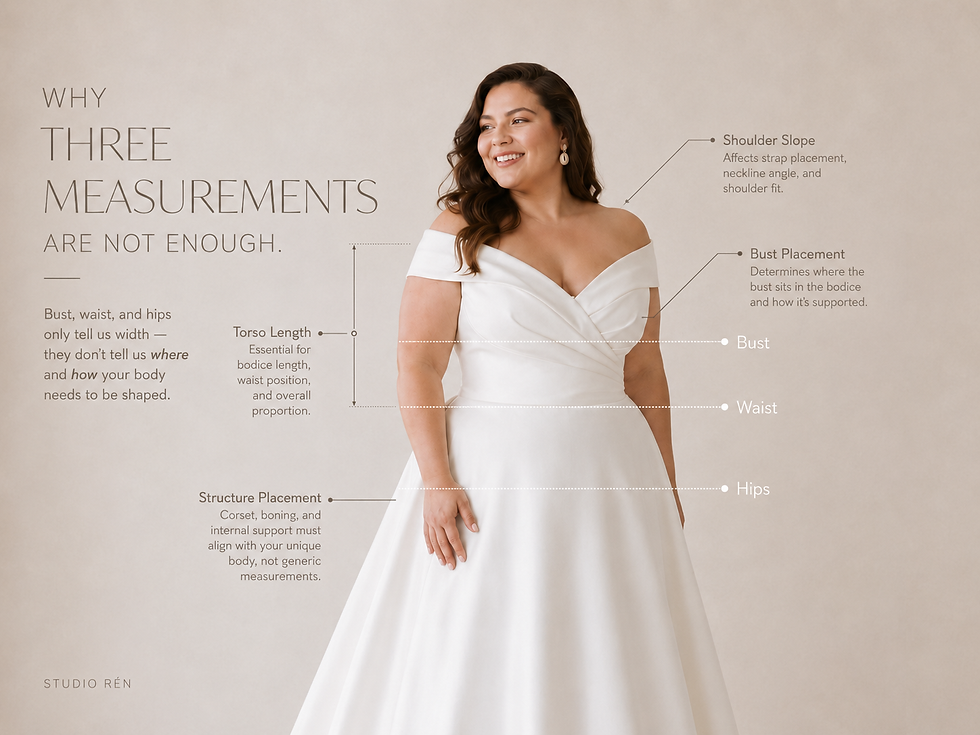
Bust, waist, and hip measurements describe the circumference of your body at three horizontal points. They tell a pattern maker how wide the garment needs to be at those points. They tell them nothing about the vertical distances between those points, the position of your bust apex, the slope of your shoulders, the width of your back, or how your torso distributes between your bust and your waist.
Every one of those missing variables affects how the finished gown sits on your body. And none of them appear in a standard three-measurement brief.
Bust, waist, and hips tell you size. They do not tell you fit.
If you are still comparing process types, start with our complete guide to ordering a custom wedding dress online before going further.
Technical Designer's View: Measurements Are Not Numbers. They Are Pattern Decisions.
From a technical design perspective, a measurement is only useful if it tells the pattern maker where something needs to happen on the body. Bust, waist, and hip measurements tell us width. They do not tell us where the bust sits, where the waist seam should land, how much length exists between the shoulder and waist, or how the body changes from front to back.
In bridalwear, those missing details matter because the gown is not a loose garment. A structured bodice, corset, strapless neckline, fitted sleeve, or mermaid skirt needs to align with the bride's actual anatomy. If the bust apex, shoulder slope, torso length, or hip placement is wrong, the issue is not cosmetic. It becomes a construction problem.
This is why Studio RÉN treats measurements as design inputs, not order-form data. The goal is not only to make the gown the right size. The goal is to place the structure, seams, support, and proportion in the right position on the bride's body before production begins. This is also why Studio RÉN's Preview My Gown process starts with proportion and design validation before production begins.
A custom gown does not fail because the bride's body is difficult. It fails because the pattern was built from incomplete information.
The Measurements That Actually Determine Fit

A pattern built for a specific body requires a significantly more detailed measurement set than most brides expect. The most important point is that a complete bridal measurement set includes both circumference measurements and placement measurements. Circumference tells us width. Placement tells us where the gown's structure needs to sit. Here is what actually needs to be measured and why each one matters.
What Measurements Are Needed for a Custom Wedding Dress?
Measurement | What It Controls | What Goes Wrong Without It |
High Bust | Upper chest and bodice frame | Back too wide, strapless bodice slides |
Full Bust | Front bust volume | Pulling, flattening, or gaping |
Torso Length | Bodice length | Waist seam sits too high or too low |
Bust Apex | Cup and dart placement | Darts point wrong, cups sit off-center |
Shoulder Slope | Neckline and shoulder balance | Neckline tilts, straps pull |
Back Width | Armhole and upper back fit | Back pulls or bunches |
High Hip | Skirt release point | Skirt volume starts in wrong place |
Full Hip | Seat and lower body room | Fitted skirt pulls or twists |
Waist to Floor | Hem length | Hem reads uneven or too short |
Bicep | Sleeve comfort | Sleeves feel tight or restrict movement |
Why High Bust Matters More Than Most Brides Realize
The high bust is taken across the chest above the fullest point of the bust, directly under the arms. This measurement captures the structural circumference of your upper chest and is essential for sizing bodice construction, particularly for strapless and structured necklines. A bodice sized from the full bust alone on a bride with a larger cup size will be too wide across the back. The high bust corrects for this.
The difference between high bust and full bust indicates cup size from a pattern perspective. A significant difference means the bodice needs specific cup shaping built in. Without it, the fabric will either pull across the front or stand away from the chest.
Why Strapless Wedding Dresses Need Shoulder and Upper Chest Measurements
A strapless or off-the-shoulder bodice has no strap to hold it in place. Its stability comes entirely from how precisely the upper chest and back measurements match the construction. The shoulder width, back width, high bust, and bust apex placement all determine whether the bodice can sit securely without sliding, gaping, or digging in. Missing any of these is not a minor gap in information. It is a structural problem built into the gown before production starts.
Why Torso Length Changes the Whole Bodice
This is one of the most critical measurements in custom gown production and one of the most frequently omitted from standard briefs. The distance from the high bust line to the natural waist determines the bodice length. Two brides can both measure 90 centimeters at the full bust and have torso lengths that differ by 4 or 5 centimeters. A bodice cut for one will sit incorrectly on the other, regardless of how accurate the circumference measurements are.
Short-waisted brides need a condensed bodice. Long-waisted brides need more length between the bust and the waist seam. This is not a small adjustment. It is a fundamental pattern decision.
Why Bust Apex Placement Affects Cups, Darts, and Necklines
The bust apex is the fullest point of the bust. Its vertical position on the body, measured from the shoulder or from the nape of the neck, determines where cups and dart points sit in the pattern. A dart aimed at the wrong apex point will create a pull or a bubble in the fabric, regardless of how well the circumference measurements were matched.
The horizontal distance between apex points, measured from center to center, determines how cups are positioned across the front of the bodice. Brides with a wider-set bust need a different cup placement than brides with a closer-set bust, even at the same full bust circumference.
Shoulder Width and Slope
The shoulder measurement is taken from the base of the neck to the shoulder point. This determines the width of the shoulder seam and directly affects how off-the-shoulder, strapless, and strapped necklines sit on the body.
Shoulder slope describes the angle at which the shoulder drops from the neck to the shoulder point. Most bodies are not level across the shoulder. A bride with a significant shoulder slope needs a shoulder seam angled to match. Without this adjustment, the back and front of the bodice will pull differently, and the neckline will not sit parallel to the floor.
Back Width and Nape to Waist
Back width is measured across the back from armhole to armhole. This determines how much fabric sits flat across the shoulder blades. A back that is too narrow pulls the armhole seams toward the back. A back that is too wide creates excess fabric bunching at the shoulders.
Nape to waist is the vertical distance from the top of the spine to the natural waist, measured along the back. It is the back equivalent of the front torso length and is often a different measurement on the same body. A pattern that does not account for this creates a bodice back that sits too high or too low.
High Hip and Full Hip
The high hip, taken approximately 7 to 9 centimeters below the natural waist, determines how the skirt releases from the body at the top. The full hip, taken at the widest point of the hip and seat, determines how much room is needed through the lower skirt and across the seat. For fitted silhouettes, both are essential. For A-line and ballgown silhouettes, the high hip affects where the skirt volume begins.
Waist to Floor and Hollow to Floor
Waist to floor, measured standing in wedding shoes, determines hem placement. Hollow-to-floor is used for sheath and column silhouettes to ensure the hem reads correctly from the front. These two measurements account for posture and body proportions in a way that height alone does not.
Bicep and Upper Arm
For any gown with sleeves, the bicep circumference is essential. An ill-fitting sleeve that is too tight across the upper arm is one of the most common fit complaints on custom gowns with long or fitted sleeves. This measurement is entirely missing from standard three-point briefs.
Why Two Brides with the Same Numbers Need Different Patterns

Consider two brides. Both measure 94 centimeters at the full bust, 72 centimeters at the waist, and 98 centimeters at the hip.
Bride A has a torso length of 36 centimeters from high bust to waist, widely spaced apex points at 20 centimeters apart, a significant shoulder slope, and a full hip that is 4 centimeters lower than average. She is proportioned with a longer waist and a lower, broader seat.
Bride B has a torso length of 31 centimeters, closely set apex points at 16 centimeters apart, level shoulders, and a full hip that sits higher on her body. She is shorter-waisted with a higher, rounder seat.
If you cut the same pattern for both brides using only bust, waist, and hip, neither dress will fit correctly. Bride A's bodice will be too short with darts pointing in the wrong direction. Bride B's skirt volume will begin in the wrong place. Both brides will need extensive alterations to correct problems that should not have been built in the first place.
This is especially important for a plus-size custom wedding dress, where the difference between circumference and support placement can be significant. This is not an edge case. This is the normal variation of human bodies.
Why Plus Size Custom Wedding Dress Measurements Need More Than Circumference

Plus-size custom wedding dress measurements need to account for proportion, support, cup placement, torso length, and how weight is distributed through the bust, waist, high hip, and seat. Two plus-size brides can share the same bust, waist, and hip measurements and still need completely different internal structures.
For example, one bride may need more upper-chest support because the difference between her high bust and full bust is significant. Another may need a longer front bodice because her bust sits lower on the torso. Another may need the skirt volume to begin lower because her high hip is fuller than her waist measurement suggests.
This is why plus-size bridal fit cannot be solved by simply adding inches to a standard pattern. The pattern has to be built around where support, shaping, and visual balance actually need to happen on the body. A gown that fits a plus-size bride correctly is not a larger gown. It is a differently engineered gown.
What Happens When Critical Measurements Are Missing
When a custom or made-to-measure gown is produced without a complete measurement set, the pattern maker fills in the missing information with standard assumptions. Those assumptions are based on average proportions.
The result is a gown that fits the average body at those circumference points but does not account for anything that makes the bride's proportions specific. The dress arrives, the circumference measurements are correct, and it still does not fit the way the bride expected. The bodice sits too low. The neckline stands away from the chest. The sleeves pull. The skirt breaks at the wrong point on the hip.
Here is a specific production example. If the full bust is correct but the bust apex is lower than the standard block assumes, the cup can technically have enough volume and still sit too high. The bride may feel like the bodice is too small or not supportive, when the real issue is that the internal structure was placed for a different bust position. No amount of letting out the side seam fixes a cup that is in the wrong place.
These are not random manufacturing errors. They are the predictable outcome of building a pattern from insufficient information. Correcting these problems through alterations is significantly more expensive and time-consuming than building the pattern correctly from the start. Some problems, particularly those involving structural decisions such as boning placement and dart direction, cannot be fully corrected by alterations.
How Studio RÉN Uses Measurements Differently

Studio RÉN does not use measurements only to choose or adjust a size. We use them to build a bride-specific avatar, then review the gown's neckline, bodice length, waist placement, skirt release, and proportion in 3D before production begins.
Before any pattern decisions are made, Studio RÉN collects the full measurement set described above and uses it to build a bride-specific avatar. The gown is then previewed in 3D on that avatar before production begins.
This changes what measurements are for. Instead of being a list of numbers passed to a production team, measurements become the architecture of a digital body that the gown is designed around. When the neckline is placed, it is placed relative to this bride's specific shoulder width and bust height. When the bodice length is determined, it reflects this bride's actual torso length. When the skirt volume is calibrated, it begins at the correct point on this bride's specific hip.
The 3D preview then allows the bride to see whether those decisions are producing the silhouette she wanted before anything is cut. Proportion problems that usually become visible only after a gown is physically made can be reviewed at the design stage instead, when they are far easier to adjust.
A 3D preview is not a physical fitting and should not be treated as a fit guarantee. Its value is that it allows proportion, structure, and design placement decisions to be reviewed before fabric is cut, when they are still easier to adjust.
This is the system behind Studio RÉN's custom wedding dresses online process, and the reason Preview My Gown exists before production begins.

FAQ: Custom Wedding Dress Measurements
What measurements do you need for a custom wedding dress?
A complete custom wedding dress measurement set includes full bust, high bust, natural waist, high hip, full hip, torso length from high bust to waist, nape to waist, shoulder width, shoulder slope, bust apex height and width, back width, waist to floor, hollow to floor, and bicep circumference for gowns with sleeves. Bust, waist, and hip alone are not sufficient for accurate pattern construction.
Why are bust, waist, and hip measurements not enough for a custom wedding dress?
Bust, waist, and hip only measure circumference at three horizontal points. They do not show torso length, bust apex position, shoulder slope, back width, posture, or hip placement. A custom wedding dress pattern needs those measurements to place seams, cups, boning, waistlines, and skirt volume correctly on the bride's specific body.
Can two brides with the same bust, waist, and hip measurements need different dress patterns?
Yes. Two brides can have the same bust, waist, and hip measurements but different torso lengths, bust positions, shoulder slopes, and hip placement. Those differences change the bodice length, cup placement, neckline balance, and skirt shape. Using the same pattern for both produces structural fit problems in both gowns.
What is the most important measurement for a custom wedding dress bodice?
Torso length, specifically the distance from the high bust to the natural waist, is one of the most critical and most frequently omitted measurements in custom bridal production. It determines the structural length of the bodice. Without it, even a perfectly sized bodice in circumference will sit at the wrong point on the body.
What measurements matter most for a strapless wedding dress?
A strapless wedding dress needs high bust, full bust, bust apex placement, shoulder width, back width, torso length, and waist placement. These measurements determine whether the bodice can sit securely without gaping, sliding, or digging in. The high bust is particularly important because it captures the structural circumference of the upper chest independently of the bust projection.
Do plus-size wedding dress measurements need to be different?
Plus-size custom wedding dress measurements need to capture proportion, bust support, torso length, high bust, full bust, high hip, and seat placement. The goal is not just to add width. The pattern must place support and shaping correctly on the body. Two plus size brides can share the same three measurements and need completely different internal structure.
What happens if my custom dress is made without all the measurements?
When measurements are missing, the pattern maker fills in the gaps with standard proportions. The gown may match the bust, waist, and hip measurements, but still fit incorrectly because the bodice length, bust apex, shoulder slope, back width, or hip placement was assumed. This can cause a neckline to gape, cups to sit too high, darts to point incorrectly, or skirt volume to break at the wrong place. Some of these issues can be altered, but structural problems involving boning, cup placement, or dart direction are difficult to fully correct after the gown is made.
How does Studio RÉN use measurements in the custom gown process?
Studio RÉN collects a full measurement set and uses it to build a bride-specific 3D avatar before any pattern decisions are made. The gown design is developed on that avatar, meaning every structural decision is made relative to this bride's specific proportions. The design is then previewed in 3D before production begins so proportion and fit decisions can be reviewed before fabric is cut. The timing of measurements also depends on the design stage, which is why brides should understand the full custom wedding dress timeline before production begins.
Do I need to take measurements myself?
Studio RÉN provides detailed measurement guidance after your preview request is submitted. You do not need to know how to take a full bridal measurement set independently before reaching out. The guidance covers exactly which measurements are needed, how to take each one accurately, and what to do if you are unsure about a specific measurement.
Studio RÉN is a custom bridal platform creating made-to-measure wedding dresses through bride-specific avatars, 3D gown previews, and custom design development. Brides can preview the fit, silhouette, and design direction of their gown before production begins.


Comments