
Can a Wedding Dress Be Let Out If It Is Too Small? A Technical Designer Explains

Yes, some wedding dresses can be let out, but only if the dress was constructed with enough hidden allowance and the internal layers allow the release. The real answer is not based on size alone. It depends on what is inside the dress: seam allowance, lining allowance, lace placement, boning channels, fabric behavior, and where the tightness is happening.
The fastest way to know is to inspect the inside of the dress, not the outside.
Whether a wedding dress can be let out is not decided at the fitting. It was decided when the dress was cut, lined, structured, and sewn.
This post is for brides who have received a wedding dress that is too small, brides researching whether alterations can fix a fit problem, and brides who want to understand why made-to-measure production reduces this risk before it happens.
What You'll Learn
The five construction checks that determine whether a wedding dress can be let out
Why fabric type, seam allowance, lace placement, and boning each change what is possible
What to ask your alterations specialist, and when letting out is not the right fix
Table of Contents
The 5 Construction Checks That Decide Whether a Wedding Dress Can Be Let Out

Before any alterations specialist opens a seam, these five construction elements determine what is physically possible.
Construction Check | What to Look For | What It Means |
Seam allowance | Is there extra fabric inside the seam? | No extra fabric means the dress cannot be released at that seam. |
Lining allowance | Does the lining have the same extra fabric? | The outer fabric cannot be let out more than the lining allows. |
Lace placement | Are lace motifs sitting on or near the seam? | Lace at the seam may block the alteration or require expensive hand repositioning. |
Boning channels | Is boning sewn into the side seam or bodice panel? | Letting out may require rebuilding internal structure. |
Fabric memory | Does the fabric show needle holes, press marks, or seam ghosts? | The alteration may be possible but visibly imperfect. |
A bridal alterations specialist needs to examine all five before giving an honest assessment. An answer based on the outside of the dress alone is a guess.
Technical Designer's Note: The Alteration Range Is Set Before the Dress Is Sewn
In production, the alteration range is decided before the dress is sewn. When I build a wedding dress pattern, I decide how much seam allowance each key seam receives, whether the lining mirrors the outer layer, where lace motifs sit relative to seams, and whether boning channels can be adjusted later. A bride usually discovers those decisions only when the dress arrives too small.
A standard alteration asks: can we fix what was already made?
Studio RÉN asks earlier: how should this be built so the risk is lower before it is cut?
That is the construction difference. And it is why understanding what creates the problem is just as important as knowing how to fix it.
What Seam Allowance Actually Is and Why It Matters

Seam allowance is the fabric left between the seam line and the cut edge of the fabric panel. In standard garment production, seam allowances range from half an inch to one inch. In bridal production, the range varies significantly depending on the maker.
A full one-inch seam allowance on both sides of a side seam gives an alteration potential of up to two inches total at that seam. The problem is that seam allowance is a production decision made before the dress is cut. If the maker cut to a tight allowance because they were conserving expensive fabric, or because they assumed the dress would fit, there is nothing an alterations seamstress can add back. The fabric does not exist.
This is why the question "can this dress be let out" has a completely different answer before versus after production. Before production, the seam allowance can be specified. After production, you work with whatever was left.
For a deeper look at why custom wedding dress measurements matter to this problem, the measurement post explains how production decisions connect to fit outcomes.
Fabric Type Changes Everything
Not all fabrics behave the same way when a seam is released.
Satin and mikado are relatively forgiving when let out. The surface is smooth and uniform. Once the seam is released and re-sewn, the fabric lies flat and the change is generally not visible.
Crepe is trickier. Crepe can show seam impression lines - the ghost of where the original seam was pressed. On lighter colored crepe this can be visible in certain lighting conditions.
Chiffon and organza are difficult to let out because the fabric is sheer. Any needle holes from original stitching, or variations in the edge finish, can show through the fabric.
Lace is the most complex case and is covered in the next section.
Duchess satin with a heavy backing can be released at the seam but may show press marks where the original seam allowance was folded.
Lace Placement Is the Most Common Let-Out Blocker

In many custom and semi-custom wedding dresses, the lace is not a separate layer floating over the surface. It is placed specifically relative to the seam line.
When a lace motif is positioned directly at or near the seam, releasing that seam creates two problems.
If the lace is part of the main fabric panel, moving the seam changes where the motif sits relative to the seam edge. If the lace is hand-applied on top of a base fabric, the base fabric may shift but the lace remains fixed - creating a gap or pucker where the layers no longer sit together.
For a heavily laced dress - particularly one with large motifs at the side or back seam areas - letting out is often not possible without repositioning lace by hand. That is a significant and expensive undertaking and one that may not fully restore the original look.
Beading adds another layer of difficulty. If beads, sequins, or pearls are sewn across the seam area, they may need to be removed before the seam can be opened and then re-applied by hand afterward. This makes the alteration slower, more expensive, and more likely to leave visible evidence of the original construction.
Boning and Internal Structure Cannot Simply Be Moved
A structured bodice contains boning channels sewn into the interior of the dress. These channels hold rigid or semi-rigid boning and run vertically through the bodice panels. They are not floating inside a pocket that can simply be relocated.
When a structured bodice needs to be let out at the side seam, the boning channel at that seam is directly affected. The boning must be removed, the channel re-constructed in a new position, and the boning re-inserted. This is technically possible but significantly more involved than releasing a simple seam.
For dresses with a full corset construction - where the bodice interior is entirely boned across the front and sides - letting out is rarely a clean operation. The corset is a structural system. Increasing its circumference after construction requires reworking the entire structure, not just releasing an edge.
Lining and Underlining - The Hidden Constraints
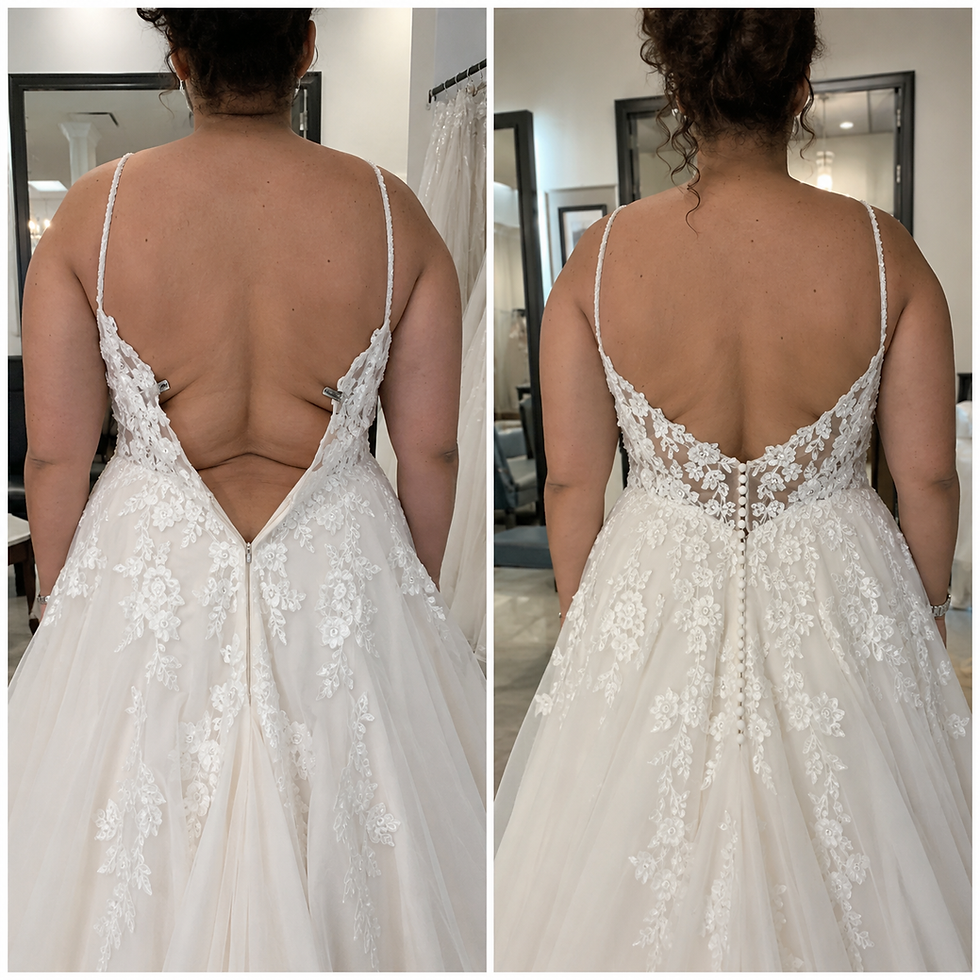
Most wedding dresses have a lining - an inner layer that sits against the body. When the outer fabric is let out, the lining must also be let out by the same amount. If the lining has less allowance than the outer fabric, the outer release is limited by what the lining can accommodate.
Underlinings - supporting fabric layers cut and sewn to the wrong side of the main fabric before construction - add another constraint. If the underlining was cut with tight allowances, releasing the outer seam without releasing the underlining creates puckering.
A dress with a single outer layer and a simple lining is relatively easy to work with. A dress with an outer fabric, an underlining, a structured corset layer, and a lining is a four-layer release problem at every seam - and each layer needs enough allowance to make the release possible.
Where the Dress Is Too Small Changes the Fix
Brides search for this question differently depending on which part of the dress is tight. The location of the problem directly changes what is possible.
Tight Area | What It Usually Means | Can Letting Out Help? |
Bust | Cup volume, bust apex position, bodice width, or neckline tension | Sometimes, but cup placement may need restructuring beyond a simple seam release. |
Waist | Circumference issue or waist seam placed at the wrong point | Often, if seams and lining have allowance at that point. |
High hip | Pattern shape issue, not just size | Maybe, but depends on seam shape and how the skirt was cut. |
Back zipper | Back width, closure type, or bodice structure | Sometimes, but a panel addition or corset conversion may be more realistic. |
Torso length | Vertical proportion mismatch | No. Letting out width will not fix a length problem. The neckline will still sit too low. |
Understanding where the tightness is actually happening is step one before any alteration decision.
A Simple Decision Tree Before You Pay for Alterations

Before paying for alterations, work through these steps in order:
Turn the dress inside out.
Check the side seams and back seams for extra fabric beyond the stitch line.
Check whether the lining has the same allowance as the outer fabric.
Check whether lace, beading, or boning crosses or sits near the seam.
Identify whether the tightness is a width problem, a length problem, or a proportion problem.
Take the dress to a bridal alterations specialist before opening any seam yourself.
Ask the specialist to examine the interior construction, not just measure the gap.
This sequence matters because opening a seam without understanding the internal construction can cause problems that are harder to fix than the original one.
How Much Can a Wedding Dress Typically Be Let Out?

Brides should approach this number conservatively.
A dress with good seam allowances in a clean fabric with no lace at the seam lines may gain about one to two inches total in circumference in realistic alteration scenarios. In some cases, if multiple seams have enough allowance and the lining, lace, and structure all allow it, the release may be slightly greater. But brides should not assume every seam can be released to its maximum - in practice, at least one seam is usually blocked by lace, boning, or a tight lining.
The specific number for any dress requires a physical examination of the interior by an experienced bridal alterations specialist. It cannot be determined from a photograph or a description of the problem.
If your body changed after ordering, the same construction rules still apply: the dress can only be released where the fabric, lining, structure, and surface details allow it.
Do Not Open the Seams Yourself
If a wedding dress is too small, do not start opening seams at home.
Bridal gowns are often built in layers: outer fabric, lace, underlining, boning, lining, and sometimes a separate corset structure. Opening one seam without understanding the internal construction can distort the bodice, release tension unevenly, damage lace, or expose needle holes that cannot be hidden again.
A bridal alterations specialist examines the interior construction first, understands which layers are attached to which, and makes decisions about sequencing the alteration to protect each layer. This is skilled technical work, not a simple seam opening.
When Letting Out Is Not the Right Fix
Sometimes a dress is too small in a way that letting out the side seams cannot correct. The most common examples:
The neckline sits too low because the torso length is shorter than the dress was built for. Releasing side seams adds width but does not change the vertical position of the neckline.
The bodice cups point in the wrong direction or sit at the wrong height because the bust apex position in the pattern does not match the bride's body. Releasing seams does not reposition cups.
The skirt pulls because the high hip is significantly larger than the standard block used for the pattern.
Releasing the seam may help but if the pattern shape itself is incorrect, the release may not be sufficient.
The back closure cannot close because the back panel width is insufficient. Depending on the closure type and structure, a panel addition or closure change may be more realistic than a let-out.

These are fit problems that originate in the pattern, not in a minor size discrepancy. Letting out the seams is a mechanical operation that increases the circumference. It cannot correct proportion mismatches, reposition structural elements, or add length where none exists.
For more on what to do when your wedding dress doesn't fit, the fit post covers the full range of alteration options and when to pursue them.
What to Ask Your Alterations Specialist
Bring this list to your appointment. A specialist who has examined the interior of the dress should be able to answer every one of these clearly.
How much seam allowance is available in the outer fabric at the tight area?
Does the lining have the same allowance?
Will the original stitch line, press mark, or needle holes show after the release?
Does any lace, beading, or appliqué cross the seam or sit close to it?
Will boning channels need to be moved or rebuilt?
Is the problem width, length, cup placement, or proportion?
Is letting out the cleanest fix, or would a panel addition, closure change, or bodice restructure be more realistic?
Any alterations specialist who cannot answer these questions after examining the interior of the dress is not yet ready to give you an accurate assessment.
FAQ: Can a Wedding Dress Be Let Out?
Can a wedding dress be let out if it is too small?
Sometimes, but it depends entirely on the construction. A dress can only be let out if there is enough seam allowance in the outer fabric, the lining, and any underlining layers, and if lace placement, boning channels, and structural elements at the seam allow for the release. In many cases the answer is no, or only partially. The construction decisions made before the dress was cut determine what is possible at the alteration stage.
Can a wedding dress be let out if the zipper will not close?
Sometimes. If the dress is only slightly tight and there is enough seam allowance in the back or side seams, the dress may be let out. If the zipper will not close because the back panel is too narrow, the bodice is heavily structured, or the closure area has lace or boning directly at the seam, a panel addition or closure change may be more realistic than a simple let-out.
Can a wedding dress be let out in the bust?
Sometimes, but bust fit is not only a circumference issue. If the cups are too small, the bust apex is misplaced, or the neckline is pulling downward, releasing the side seams may not solve the problem. A bust alteration may require cup replacement, bodice reshaping, or internal structure changes that go beyond a seam release.
Can a wedding dress be let out in the hips?
Sometimes. Hip release depends on seam allowance, skirt shape, fabric behavior, lining allowance, and whether the high hip area was drafted correctly in the pattern. If the hip issue comes from a pattern shape problem rather than simple tightness, releasing the side seams may not fully correct the fit.
Can lace wedding dresses be let out?
Lace wedding dresses are the most difficult to let out because lace placement relative to the seam line directly affects what is possible. If lace motifs are positioned close to or at the seam, releasing the seam disrupts the placement or separates the lace from the base fabric. A lace dress with lace concentrated away from the seam lines is more workable than one with allover lace up to the edge.
Can a boned or corset wedding dress bodice be let out?
Releasing a boned bodice is significantly more complex than releasing a plain seam. Boning channels must be re-sewn in new positions, which requires removing and re-inserting the boning. A full corset construction is a structural system and cannot typically be let out in the same way a simple seamed bodice can.
What is seam allowance in a wedding dress?
Seam allowance is the extra fabric left between the sewn seam line and the cut edge of the fabric panel. It determines how much the seam can be released if the dress needs to be made larger. In bridal production, seam allowances vary significantly between makers. A one-inch seam allowance gives meaningful alteration range. A quarter-inch allowance gives almost none.
Can a panel be added if my wedding dress cannot be let out?
Sometimes. If there is not enough seam allowance to let the dress out, an alterations specialist may be able to add a matching or intentionally designed panel at the back, side, or closure area. This depends on fabric availability, lace placement, bodice structure, and whether the added panel will look intentional rather than like a repair.
What should I do if my wedding dress arrived too small?
Take the dress to an experienced bridal alterations specialist as soon as possible. Ask them to examine the interior construction - specifically the seam allowances, lining, boning, and lace placement - before confirming whether letting out is possible. Do not attempt to open seams yourself. If the dress cannot be let out sufficiently, ask about alternative approaches: adding a panel, changing the closure type, or restructuring the back.
Studio RÉN is a custom bridal platform creating made-to-measure wedding dresses through bride-specific avatars, 3D gown previews, and custom design development. Brides can preview the fit, silhouette, and design direction of their gown before production begins.


Comments