
Princess-Inspired Wedding Dresses: How The Same Design Changes From Size 4 To Size 12

A princess-inspired wedding dress does not fail because the bride chose the wrong silhouette. It fails because the design was copied instead of translated. Cinderella's structured ball gown, Ariel's sculpted mermaid line, and Belle's off-shoulder skirt are not blueprints to replicate exactly. They are design references that need to be re-engineered for each bride's body, proportions, and measurements before a single seam is cut.
This post shows exactly how that translation works across Cinderella, Ariel, and Belle. And what changes when the same princess-inspired design is built for a size 4-6 body versus a size 10-12 body.
Editorial Note: This article discusses fairy-tale character design references for editorial and educational purposes. Studio RÉN is not affiliated with, sponsored by, or endorsed by Disney, Disney Fairy Tale Weddings, or Allure Bridals. Studio RÉN does not sell licensed Disney gowns. The examples below show how fairy-tale design language can be translated into custom bridal silhouettes built to a bride's exact measurements.
What You’ll Learn
How the same princess-inspired wedding dress design changes from size 4 to size 12 in silhouette, construction, proportion, and fit.
What technical adjustments make a Cinderella-inspired ball gown, Ariel-inspired mermaid gown, or Belle-inspired off-the-shoulder wedding dress work across different body sizes.
Why neckline width, bodice support, waist placement, skirt volume, flare point, and appliqué placement need to be redesigned instead of simply graded up.
How a bride-specific 3D wedding dress preview shows the gown on your actual proportions before production begins.
How Studio RÉN uses custom measurements and bride-specific avatars to reduce fit, proportion, and production risk before the dress is made.
TABLE OF CONTENTS
This Guide Is For Brides Asking:
Can I wear a princess-inspired wedding dress if I am not a sample size?
How does the same wedding dress design change from size 4 to size 12?
Will a ball gown wedding dress work on a fuller bust, waist, or hip?
Can a mermaid wedding dress work on different body sizes?
How should an off-the-shoulder wedding dress be adjusted for my proportions?
Why does a wedding dress look different on a size 4 bride versus a size 12 bride?
What construction details change across body sizes, including neckline width, bodice support, waist placement, skirt volume, and flare point?
How can a fantasy-inspired or princess-inspired wedding dress look elegant and bridal instead of costumey?
Can I preview a custom wedding dress on my body before production begins?
How does Studio RÉN use a bride-specific 3D avatar to reduce fit and proportion risk before the gown is made?
Why a Princess-Inspired Wedding Dress Should Not Be Copied Across Sizes
The Direct Answer: A princess-inspired wedding dress should not be copied exactly from size 4-6 to size 10-12. The design reference can stay the same, but the neckline width, bodice structure, waist placement, skirt volume, flare point location, and applique layout often need to change so the gown keeps the same visual intention on a different body. Size alone does not drive these decisions. Proportion, torso length, bust volume, and hip-to-waist ratio all factor in. That is what custom design is for.
A Note on Size vs. Proportion: Size alone does not determine how a gown needs to be built. A size 10-12 bride can have a short torso, long torso, fuller bust, narrow shoulders, fuller hip, or straighter frame. The simulations in this post compare two size ranges as a starting reference point. The real design decision always starts from the bride's measurements and proportions, not a number on a size chart.
What Changes Across Sizes, and Why
What Changes | Why It Changes |
Neckline Width | To frame the chest and shoulders proportionally |
Bodice Structure | To support bust volume, movement, and wear time |
Waist Placement | To match torso length, not a standard size chart |
Skirt Volume | To scale fullness without adding bulk |
Mermaid Flare Point | To preserve movement and silhouette |
Applique Placement | To balance detail across a different surface area |
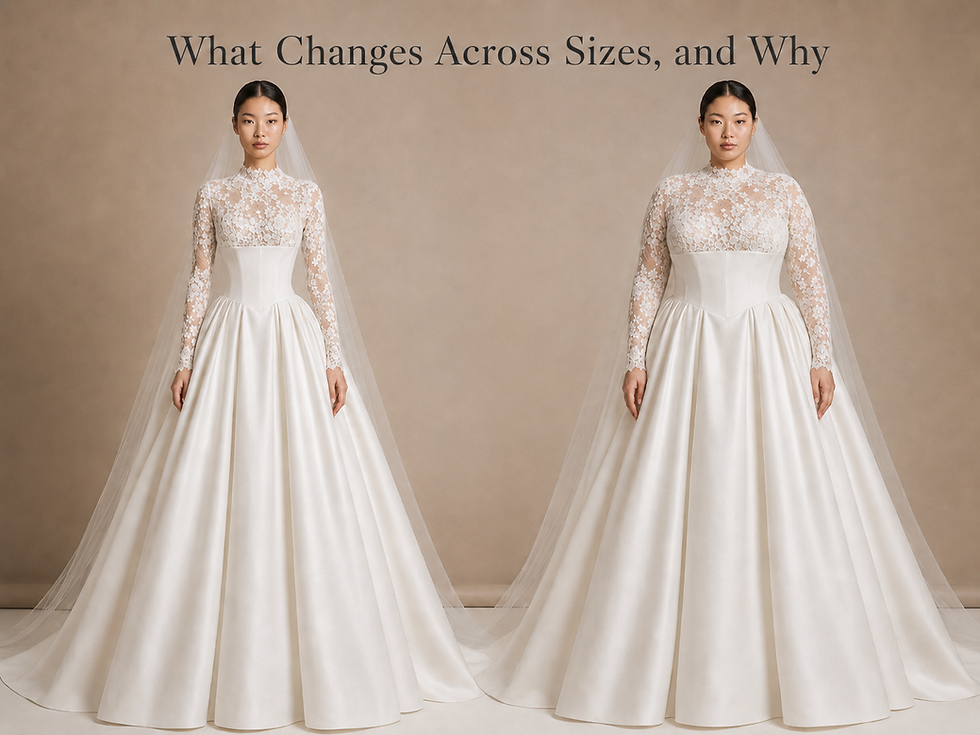
The sample-size bridal industry was built around a single body. Most inspiration images, runway looks, and designer sketches are developed on a size 4-6 fit model. The proportions were drafted for that frame. The seam placement, neckline width, waist drop, skirt volume, and boning structure were all calibrated to that body.
When a different body wears the same gown without any technical adjustment, the design intent breaks down. A neckline that looked clean and balanced on a narrower frame can read as compressed on a wider one. A ball gown that created the right visual ratio on a shorter torso can overwhelm a taller one. A mermaid flare point that read as elegant can become restrictive if placed at the wrong position on the leg.
This is not a problem with the bride. This is a problem with the process.
Custom bridal design solves this by starting with the bride's custom wedding dress measurements, not a standard block. But even within custom, the design itself needs to change. Not just the sizing. The same princess inspiration can be built for any body. The construction, proportion, and technical decisions just need to be made with that body as the starting point.
Which Princess-Inspired Silhouette Fits Which Bridal Goal?
Not every princess inspiration leads to the same silhouette. Before looking at how the design changes across sizes, it is worth knowing which direction fits your goals.
Bridal Goal | Strongest Direction | Why |
Defined waist and dramatic entrance | Cinderella-inspired ball gown | Strong bodice plus controlled skirt volume |
Sculpted body line and dramatic train | Ariel-inspired mermaid gown | Close fit through hip and thigh with calibrated flare |
Romantic neckline and fuller skirt | Belle-inspired off-shoulder gown | Frames shoulders and creates strong waist emphasis |
More movement and less weight | Soft ball gown or fit-and-flare | Keeps the fantasy feeling without excessive structure |
Fuller bust support as a priority | Strapless or off-shoulder with internal corsetry | The visible neckline requires hidden engineering underneath |
In all cases, the silhouette that creates the right effect on a sample-size inspiration image needs to be re-engineered for your specific proportions. The sections below show exactly how.
Cinderella-Inspired Wedding Dress: Size 4-6 vs. Size 10-12
The Core Design Idea
Cinderella's gown is built around a few defining elements: a structured, close-fitting bodice; a full, airy ball gown skirt; a light-reflective fabric (typically satin, mikado, or duchess satin); and a cool ivory or blue-white tone. The bodice lifts and defines the waist. The skirt creates volume from the hip down without adding visual weight above it.

Size 4-6 Translation
On a size 4-6 body with proportional torso length and moderate bust, the Cinderella silhouette is technically straightforward. The bodice can be structured with lighter internal boning. A sweetheart or strapless neckline stays proportional without needing extra width. The skirt can be built with 4-6 layers of tulle over a crinoline, with a horsehair-weighted hem that maintains shape without weight. Embellishment can be distributed more densely at the center front without creating visual crowding.

Size 10-12 Translation
On a size 10-12 body, each of those decisions needs to be revisited.
The bodice requires more internal structure. If the gown is strapless or sweetheart, the boning needs to span a wider front panel and provide vertical lift across more breast tissue. Without this, the bodice will gap, pull, or roll forward. The neckline width needs to be widened so it does not read as compressed across the chest.
The waist seam must be measured to the bride's actual waist, not derived from a standard drop. Torso length varies significantly across sizes. On a longer torso, the waist seam may need to sit lower to avoid shortening the skirt proportion.
Ball gown skirt volume requires careful calibration. More tulle is not automatically better. The goal is a skirt that reads as full and intentional, not overwhelming. The width at the hem should be scaled to the hip circumference so the proportion between the bodice and skirt reads as balanced. Crinoline structure matters here. The right underskirt keeps the silhouette lifted and clean. The wrong one collapses or spreads.
Cinderella: Design Translation at a Glance
Design Decision | Size 4-6 | Size 10-12 |
Neckline | Narrower sweetheart or strapless span reads proportional | Wider neckline span needed to avoid compressed look across chest |
Bodice Structure | Lighter boning sufficient at moderate bust volume | Boning spans wider panel with stronger vertical lift and anchoring |
Waist Placement | Standard waist drop may work on proportional torso | Must be measured to bride's actual torso - not a pattern standard |
Skirt Volume | 4-6 tulle layers over crinoline reads full and controlled | Volume must scale to hip circumference - more layers is not better proportion |
Construction Risk | Can read too simple if underbuilt | Can read bulky or overwhelming if overbuilt |
Designer Note From Orly: When I build a ball gown across sizes, the first thing I check is not the skirt. It is the waist seam position relative to the bride's actual torso length. If that measurement is off, nothing above or below it will read correctly. The skirt can be perfect and still look wrong.
Ariel-Inspired Wedding Dress: Size 4-6 vs. Size 10-12
The Core Design Idea
An Ariel-inspired gown is built around sculpted fit, fluid fabric, and a mermaid or fit-and-flare line. The design follows the body closely through the hip and thigh before releasing into a trained flare. Fabric choices lean toward liquid satin, charmeuse, stretch crepe. Embellishment is typically shimmer-based: beading, sequins, or iridescent fabric that reads as ocean-like without being literal.

Size 4-6 Translation
On a size 4-6 body, a mermaid silhouette can be constructed with close-fitting princess seams that trace the body's natural curve. The flare point can sit lower, at or just below the knee, because there is less hip-to-thigh volume for the skirt to work against. Fabric with minimal structure, like charmeuse or liquid satin, will drape cleanly without pulling across the hip. Embellishment can be applied directly to the outer shell without adding bulk that distorts the silhouette.

Size 10-12 Translation
On a size 10-12 body, a mermaid silhouette requires more deliberate technical decisions.
The flare point placement is critical and body-specific. Too low and the skirt restricts movement at the calf. Too high and the silhouette reads as a fit-and-flare rather than a true mermaid. On a fuller hip-to-thigh body, the flare point typically needs to sit where the leg has narrowed enough for the skirt to release cleanly, without catching on the widest point of the hip or thigh.
Fabric choice matters more on a fuller body. A fabric with no internal structure, like charmeuse, will pull across the hip and thigh if there is significant volume there. A bonded crepe or structured jersey gives the same fluid appearance from the front while holding its shape across the back and side seams. Lining choice is equally important. A heavy lining adds compression. A lightweight lining adds nothing and can allow the outer fabric to shift.
Seam construction on a size 10-12 mermaid gown often needs to move from simple princess seams to a panel construction: additional side panels, curved seams, or strategic dart placement to redistribute visual weight and create a cleaner line from hip to flare.
Ariel: Design Translation at a Glance
Design Decision | Size 4-6 | Size 10-12 |
Flare Point | Can sit lower, at or below knee | Must sit where leg has narrowed - too high reads as fit-and-flare |
Fabric Structure | Charmeuse or liquid satin drapes cleanly | Bonded crepe or structured jersey prevents pulling across hip and thigh |
Seam Construction | Princess seams follow natural curve | Panel construction with curved seams or strategic dart placement |
Lining | Lightweight lining sufficient | Too heavy compresses, too light allows outer fabric to shift |
Construction Risk | May pull without enough internal structure | May restrict movement if flare point is incorrectly placed |
Designer Note From Orly: The mermaid flare point is the most misunderstood fit decision in bridal. On most inspiration images, the flare is placed for aesthetics on a sample-size body. On a real body, it is a functional measurement. If the skirt releases before the leg narrows, the bride cannot walk the length of an aisle without stopping to adjust.
Before designing any princess-inspired gown, the most common mistake brides make is starting with the silhouette instead of starting with the brief. The Custom Gown Vision Workbook walks you through design direction, silhouette priorities, fit concerns, and production questions before your first Studio RÉN design conversation. Download it free.
Belle-Inspired Wedding Dress: Size 4-6 vs. Size 10-12
The Core Design Idea
A Belle-inspired gown centers on an off-shoulder neckline, a defined waist (basque or drop waist), warm ivory or gold undertones, fuller skirt volume, and floral or rose-inspired texture. The off-shoulder element frames the collarbone and shoulders. The waist detail creates a strong horizontal line before the skirt releases.

Size 4-6 Translation
On a size 4-6 body, the off-shoulder construction can be built with lighter boning and a narrower span. The basque waist drop can follow a standard gradient from center front to hip point. Skirt volume in 3-5 tulle underlayers reads as appropriately full.

Size 10-12 Translation
On a size 10-12 body, the off-shoulder requires more structural engineering.
The neckline span must be wider. An off-shoulder neckline that ends at the same point as a size 4-6 pattern will pull inward and look narrow across a wider chest and shoulder frame. The internal support must do more work. On a size 4-6 body, a corded elastic or lightly boned neckline can hold position. On a size 10-12 body, the neckline needs a wider boning channel, a stronger internal stay, and often a loop-and-hook or internal strap system to prevent migration during wear.
The basque waist requires precise measurement. It should drop to the bride's actual low waist or high hip, not a standard drop from center front. On a longer torso, a standard basque drop can end at the wrong point and shorten the skirt's visual line. On a shorter torso, the same drop can position the waist too low.
Skirt volume on a Belle-inspired size 10-12 gown must be calibrated to the hip circumference. The hem circumference needs to be proportionally wider, the crinoline selected for lift rather than spread, and the silhouette should taper cleanly from hip to hem without creating a bottom-heavy visual effect.
Belle: Design Translation at a Glance
Design Decision | Size 4-6 | Size 10-12 |
Off-Shoulder Span | Lighter boning, narrower span holds position | Wider span, stronger boning channel, often needs internal strap system |
Basque Waist Drop | Standard gradient from center front works | Must drop to bride's actual low waist - not a pattern standard |
Skirt Volume | 3-5 tulle layers reads appropriately full | Hem circumference needs scaling - crinoline for lift, not spread |
Applique Placement | Even distribution across bodice and skirt | Concentrate at center front and hem - avoid widest hip point |
Construction Risk | Neckline can migrate if support is too light | Basque at wrong drop shortens or elongates the skirt proportion |
Designer Note From Orly: Off-shoulder necklines fail on the day more than any other bridal construction. The reason is almost always the same: the internal support was designed for the fitting, not for 8 hours of wear, dancing, and movement. On a size 10-12 body, that support needs to be engineered, not assumed.
What Actually Changes in Construction, Fit, and Proportion
Across all three princess-inspired designs, the same technical decisions repeat. Here is a direct breakdown.
Bodice Support. On a size 4-6 body with moderate bust, lighter boning is typically sufficient. On a size 10-12 body, the boning must span a wider panel, provide more vertical lift, and anchor more securely to the internal structure. This is especially critical for strapless and off-shoulder gowns.
Neckline Width. Necklines scaled directly from a smaller pattern read as compressed on a wider frame. Width adjustments are non-negotiable on sweetheart, off-shoulder, and portrait necklines. The adjustment is about visual balance, not just comfort.
Waist Placement. Waist seams, basque drops, and drop waist points must be measured to the bride's actual body, not derived from a standard pattern. On different torso lengths, the same waist placement produces completely different visual results.
Skirt Volume and Scale. More fabric is not the same as better proportion. The goal is to scale the skirt so it reads as balanced relative to the bodice and the bride's frame. This requires adjusting both layer count and hem circumference.
Mermaid Flare Point. On a fuller hip-to-thigh body, the flare point must be placed where the leg has narrowed enough for the skirt to release cleanly. This is a bride-specific measurement decision, not a pattern standard.
Surface Design and Applique Placement. On a larger surface area, applique distribution needs to be redesigned, not scaled. Center-front concentration, hem-weight emphasis, and avoiding heavy detail at the widest hip points are the core adjustments.
Why a Bride-Specific 3D Preview Matters More Than a Sample-Size Photo
Every princess-inspired gown starts as an image. Cinderella on a screen. A Pinterest reference. A mood board. What that image does not show is what the gown will look like on your body, your measurements, your proportions.
That is the problem a bride-specific 3D wedding dress preview solves.
At Studio RÉN, every bride receives a 3D gown preview built on a bride-specific avatar constructed from her exact measurements. Before any fabric is cut, the bride can see the proposed silhouette, neckline, waist placement, and skirt scale on her actual body. Not a sample-size stand-in. Her proportions. Her gown.

For princess-inspired designs specifically, this matters more than it does for simpler silhouettes. Ball gowns, mermaid lines, and off-shoulder constructions are the silhouettes most likely to misread on a body when copied without technical translation.
Designer Note From Orly: A 3D preview is not there to make the gown look impressive on a screen. It is there to catch proportion problems before fabric is cut. If the waistline is too low, the flare point is too tight, or the off-shoulder span is too narrow, I want to see that in the preview stage, not after production.
Start with Studio RÉN's Preview My Gown process to see your custom wedding dress direction on a bride-specific 3D avatar before production begins.
FAQ
Can a Disney princess-inspired wedding dress work on a size 10-12 bride?
Yes. Any princess-inspired silhouette - ball gown, mermaid, or off-shoulder - can be built for a size 10-12 body. The key is technical translation, not simple pattern grading. Construction decisions including boning structure, neckline width, waist placement, skirt volume, and flare point location all need to be adjusted to preserve the design's visual intent on a larger frame.
How should a Cinderella-inspired ball gown be adjusted for a fuller body?
A Cinderella-inspired ball gown on a fuller body requires a wider neckline, more internal boning structure, a waist seam measured to the bride's actual waist rather than a standard drop, and a skirt volume calibrated to the hip circumference. The goal is to keep the proportion between bodice and skirt reading as balanced and intentional, not to simply add more fabric.
What makes a mermaid wedding dress fit differently on different body sizes?
The flare point placement is the most critical variable. On a fuller hip-to-thigh body, the flare must release where the leg has narrowed enough for the skirt to open cleanly. Fabric choice also matters. Structured crepe or bonded jersey holds a mermaid line better than liquid satin on a fuller body. Seam construction often needs to move from princess seams to a panel construction to distribute volume more evenly.
How does an off-shoulder neckline need to change for a size 10-12 bride?
An off-shoulder neckline on a size 10-12 body needs a wider span to frame the chest and shoulders proportionally. The internal support must be stronger: a wider boning channel, a more secure internal stay, and often a loop-and-hook or internal strap system to keep the neckline in position throughout wear.
What is the difference between a princess-inspired wedding dress and a Disney wedding dress?
A princess-inspired wedding dress draws on the design language of a character - silhouette, fabric, neckline, waist detail, embellishment - and translates it into a custom bridal gown built to the bride's measurements. It is a design reference, not a licensed product. Disney Fairy Tale Weddings is an officially licensed gown collection sold through Allure Bridals and other retailers. A custom princess-inspired gown is designed from scratch.
Can a plus-size bride wear a ball gown silhouette?
Yes. A ball gown is one of the most versatile silhouettes for a range of body types because it creates a strong waist emphasis and flows away from the body below the hip. The construction details - boning structure, skirt volume, waist placement, and crinoline - need to be calibrated to the bride's measurements, not copied from a sample-size pattern.
How far in advance should I start designing a custom princess-inspired wedding dress?
Studio RÉN's production timeline is 9-12 months total, with production alone taking 6-9 months. Design development, the 3D preview process, and fabric sourcing take place before production begins. Brides should start at least 12 months before the wedding date to allow for the full timeline without rushing any production stage.
Is Studio RÉN affiliated with Disney Fairy Tale Weddings?
No. Studio RÉN is not affiliated with Disney, Disney Fairy Tale Weddings, or Allure Bridals. This post discusses princess-inspired bridal design from a custom design and fit perspective. Studio RÉN does not sell licensed Disney gowns.
What is the safest way to design a princess-inspired wedding dress without it looking like a costume?
Use the character as a design reference, not a blueprint. Translate the silhouette, neckline, waist shape, fabric behavior, and mood into a bridal gown. Avoid exact character colors, costume-specific accessories, branded imagery, and literal character styling. The goal is to capture the design language, not reproduce the outfit.
Does the same wedding dress design look different on a size 4 and a size 12?
Yes. The same design concept will look different because the neckline, bodice support, waist placement, skirt scale, and surface details all interact with the bride's proportions. In custom bridal, the goal is not to copy the same pattern across sizes. The goal is to preserve the design intention on each bride's actual body, which requires different construction decisions at different proportions.
Studio RÉN is a custom bridal platform creating made-to-measure wedding dresses through bride-specific avatars, 3D gown previews, and custom design development. Brides can preview the fit, silhouette, and design direction of their gown before production begins.
Not ready to start your gown yet? The Custom Gown Vision Workbook helps you define your design direction, silhouette, fit priorities, and production questions before your first conversation. Download it free here:


Comments